

The Real Takeaway
AI agents are becoming a key product discovery channel, which means product data quality now directly impacts visibility and revenue. Companies should focus on improving product data, ensuring real-time fulfillment capabilities, and tracking AI-driven discovery, because products that aren't accurately represented to AI agents may never make it into the buyer's consideration set.
The Behavioral Shift Is Already Underway
Commerce technology has always reshaped how buyers make decisions. E-procurement changed how companies issued orders. Marketplaces changed who they bought from. Now LLMs are changing how buyers discover products
For many B2B organizations, the challenge is not a handful of products. It is thousands, sometimes hundreds of thousands of SKUs spread across multiple systems, pricing structures, and channels.
A buyer searching for "industrial pumps under 500 GPM with stainless steel housings" may never visit your website if an answer engine can assemble recommendations directly from product data. If your products are not findable and accurately represented in those environments, you are excluded from the buying process before a salesperson knows an opportunity exists.
Traditional digital experiences remain important, but product discovery is moving into AI-driven environments.
How Product Discovery is Changing
The Traditional Path

The Agentic Commerce Path

If your product data is incomplete, your product exits the process before a human engages.
Product Data Is the Choke Point, But Not in the Way You Think
The most important step enterprise commerce teams can take is auditing product data. Platform upgrades and front-end improvements cannot compensate for incomplete or poorly structured product information.
Agentic commerce creates a different challenge than search engines or punchout catalogs. Google can infer meaning from sparse content, links, and user behavior. LLMs depend heavily on the information provided. If a product lacks technical specifications, pricing tiers, availability information, or application details, the model either returns an incomplete answer or favors a competitor with richer data.
A human buyer may call your sales team. An AI agent simply moves on.
That shift changes the competitive landscape. Increasingly, product data is becoming a selling surface. Companies can lose consideration before a human buyer ever evaluates alternatives.
New disciplines such as Answer Engine Optimization (AEO) and Generative Engine Optimization (GEO) are emerging alongside AI-powered search and shopping experiences. AEO helps AI systems find and surface relevant products when someone asks a question. GEO helps AI systems recommend or reference brands during evaluation and purchase decisions. Both depend on the quality, completeness, and accessibility of product data.
For B2B sellers, that includes contract pricing, account-specific catalogs, negotiated terms, lead times, and technical attributes. A machinery manufacturer managing thousands of configuration-specific SKUs faces a far greater challenge than a consumer brand. Solving that complexity becomes a competitive advantage when buyers increasingly rely on agents to evaluate options.
Protocols such as the Agentic Commerce Protocol and Universal Commerce Protocol are beginning to establish how AI agents discover and transact. Companies investing now will understand which data attributes drive visibility before standards mature and differentiation narrows.
Near-Term Priorities: Findability, Fulfillment, and Proactive Care
Beyond data, enterprise commerce teams should focus on three areas through 2027.
Findability
Structured data, disciplined syndication, and strong PIM governance are foundational. Visibility depends on whether AI systems view your information as complete, current, and authoritative. Organizations that treat data quality as an operating discipline will outperform those approaching it as a one-time cleanup effort.
Fulfillment Resilience
When a human buyer encounters a stockout, they often contact the supplier or search for alternatives. The seller receives a signal and has an opportunity to intervene. When an AI agent encounters the same issue, it quietly selects another option. No support ticket. No escalation. No indication you were even considered.
Companies can lose business without realizing they were part of the evaluation set.
If an agent cannot reserve inventory or verify delivery timelines in real time, it routes the transaction elsewhere. Many OMS environments designed for human-driven channels were never built for the responsiveness agent-driven transactions require.
Proactive Post-Purchase Communication
Lightweight AI agents can handle 60–70% of routine post-purchase inquiries, freeing service teams to focus on issues that require judgment and intervention. For many organizations, this remains one of the fastest paths to measurable value from AI.
Unified Commerce: The LLM as Attribution Channel
A buyer may discover your product through an answer engine, then complete the purchase through a sales representative, distributor, or e-procurement platform. The transaction happens elsewhere, but the influence started in an AI interface.
Brands that surface accurately in AI-driven discovery shape purchase decisions regardless of where the final transaction occurs. If product data determines which options enter consideration, discovery itself becomes a strategic commerce channel.
The New Commerce Attribution Problem
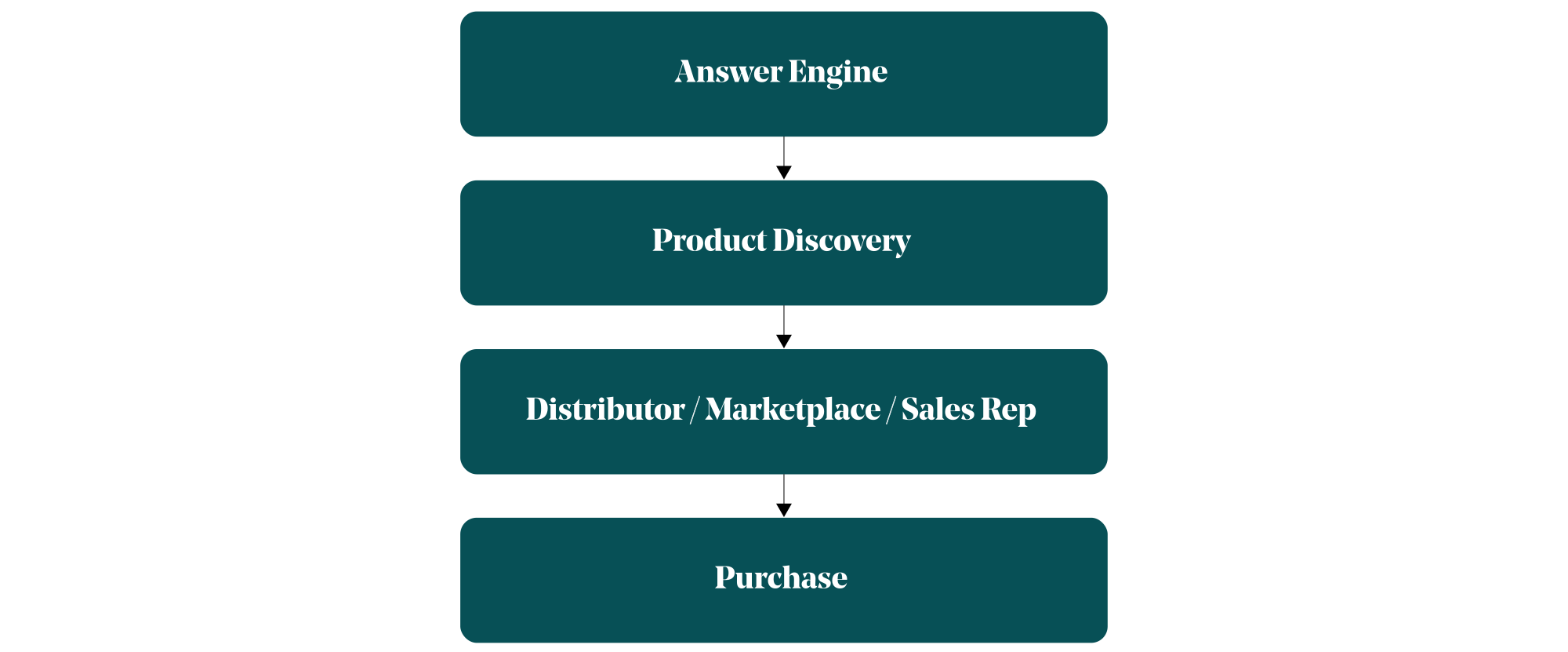
Traditional analytics often miss the AI influence layer.
Tag AI-referred traffic. Track assisted conversions originating from answer engines. Treat AI-mediated discovery as a distinct attribution channel rather than lumping it into dark traffic. What cannot be measured cannot be improved.
Closing the Readiness Gap: A Multi-Year Initiative
The mistake is assuming there is plenty of time before agentic commerce affects revenue, then scrambling to respond after buyer behavior has already changed.
Success begins with data readiness, but it also depends on fulfillment reliability and customer communication. The chief data officer owns data quality. The CIO owns protocol and architecture readiness. The CMO owns findability and attribution. Operations owns fulfillment performance. Agentic readiness requires coordinated action across the business.
What to Do Now
- Audit product data for AEO and GEO readiness, including structured attributes, enriched descriptions, and consistent syndication across PIM, ERP, and channel systems. Start with high-SKU-complexity categories and account-specific pricing models.
- Assess OMS architecture for real-time reliability. Can it support API-driven transactions, maintain inventory accuracy under heavy demand, and provide real-time order status visibility?
- Deploy AI agents for WISMO and delay communications. This is one of the most practical and immediate use cases available today.
- Build an agentic readiness roadmap using short execution cycles. Standards, protocols, and buyer behaviors are evolving too quickly for annual planning alone.
If adoption slows or a dominant platform controls the agent interface, returns may take longer than expected. That argues for phased investment, not inaction. Waiting until the market matures assumes competitors are standing still.
Brands without a strong product experience management foundation will appear in agent-mediated discovery — but with outdated pricing, incomplete specifications, and weaker product context than competitors.
When AI systems understand your competitors' products better than they understand yours, decisions are shaped before buyers reach your website, talk with a salesperson, or request a quote.
Organizations that move now will gain visibility, attribution, and insight into how agents evaluate their products. Organizations that wait may discover too late that AI systems were already deciding which options made it into consideration.
The question is not whether agentic commerce will influence buying decisions. The question is whether your products are visible, accurate, and ready to compete when agents play a larger role in determining what gets recommended.
Want a Broader View of How AI-Powered Buying Continues to Grow?
Forrester recently published The State of Agentic Commerce, Q2 2026 (Forrester Research, Inc.). Perficient was among the organizations interviewed during the research process. Readers interested in Forrester's perspective on the topic can access the report directly through Forrester.