

The Real Takeaways
Most enterprises are funding workarounds instead of fixes. Data foundations, governance, and operating discipline remain the bottlenecks. Until these are solved, higher budgets will not yield outcomes. Focus the next two quarters on data quality, workflow redesign, and measurement. Treat them as prerequisites, not differentiators.
The Problem Isn't The Budget
Enterprise AI budgets are growing. Outcomes are not keeping pace. That gap between what organizations are spending and what they are actually getting — is not a technology problem. It is a sequencing problem. And the organizations that close it first will not just run better AI. They will make their competitors' AI investments look like a waste of money.
Worldwide AI spending will hit roughly $2.527 trillion in 2026, according to Gartner. But most enterprises are scaling on top of technical debt, fragmented systems, and thin governance. The result is stalled pilots, abandoned projects, and uneven value capture.
What Leaders Often Get Wrong
- Hiring a partner means we’re moving faster. Not by default. It often means your team is thin on data engineering, integration, or MLOps. Partners help you build the plumbing you don’t have yet. That’s not speed, that’s table stakes.
- Automation will transform the business. Not if you automate broken steps. Map the work, remove the waste, then automate what’s left. Otherwise, you just make bad work go faster.
- A BI upgrade will fix decisions. Dashboards don’t fix messy data or unclear ownership. Decide who owns the metric, who can act on it, and what changes when the number moves.
- More tools raise maturity. Tools add cost and complexity without roles, standards, and runbooks. Start with who does what, when, and how you’ll measure it.
- Models are the hard part. The model is usually the easiest part. Data quality, integration, monitoring, security, and cost control are where programs stall.
Where Enterprise AI Dollars Are Going
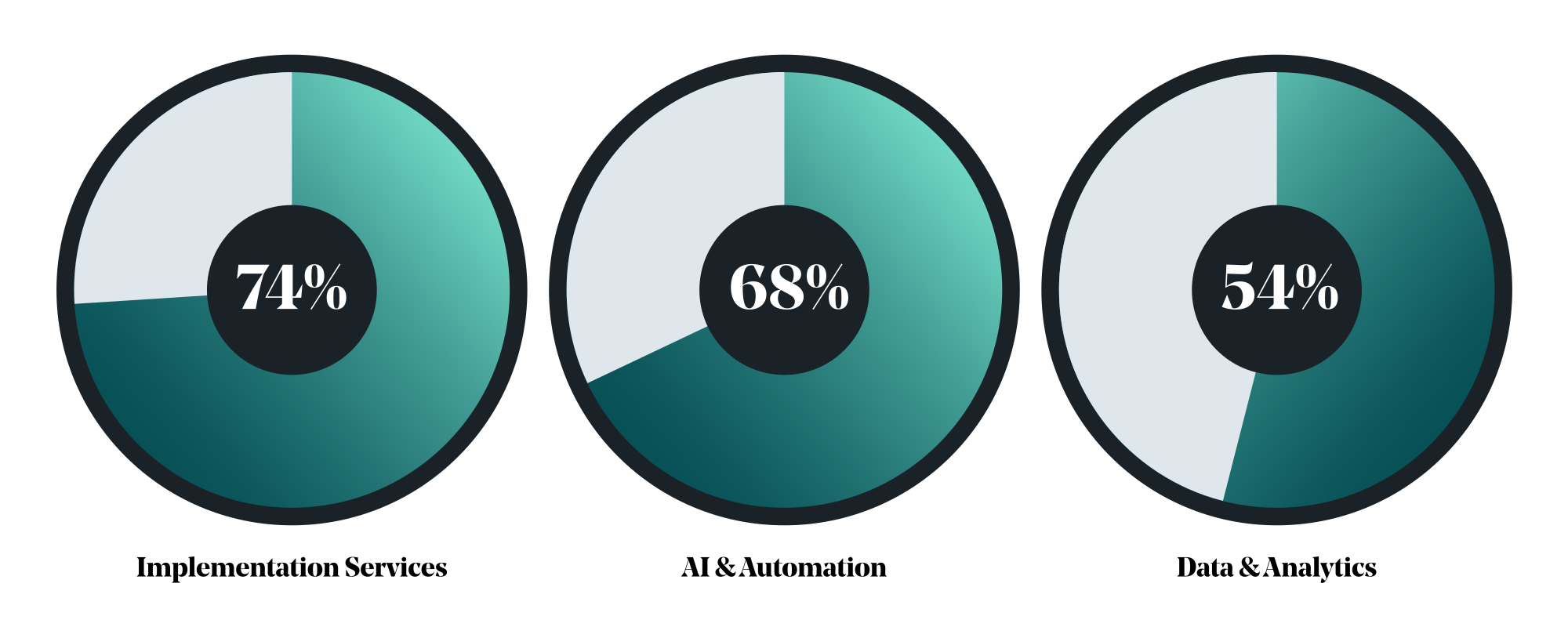
Investment appetite is real. Readiness is not. 74% of leaders plan to engage technology partners on implementation in 2026, according to Perficient's 2025 brand research (73 clients, 18 prospects). 68% plan to invest in AI and automation, and 54% in data and analytics.
The use cases tell the same story. Leaders are funding business intelligence and analytics (76%), process automation (72%), software development (65%), and customer support (62%).
These are not moonshots. They are foundational capabilities most enterprises should already have. The AI budget is being used to address years of deferred data work, unintegrated systems, and processes that were never worth automating.
This is not a technology problem. It is a sequencing problem. The organizations getting value from AI right now made foundational investments first in data quality, governance, and operating models. The ones struggling skipped those steps.
AI is only as effective as the quality, structure, and governance of the data underneath it. Skipping that step does not accelerate outcomes. It defers them.
You're just making bad work go faster.
What Readiness Actually Requires
Getting AI-ready is an operating model decision, not a technology purchase. The organizations moving from pilot to production share three traits:
- They treat data governance as infrastructure, not compliance.
- They assign clear ownership to every AI use case before code is written.
- They measure AI value in business outcomes (cycle time, cost per transaction, retention rate), not model accuracy.
That means auditing data quality, designing workflows worth automating, building governance with clear accountability, and establishing KPIs that connect AI activity to business results.
What Leadership Requires Now
The budget is approved. The use cases are clear. The constraint is not ambition or funding. It is execution discipline.
The organizations getting value from AI are not the ones with the biggest budgets. They are the ones that solved the sequencing problem: data before models, governance before scale, process clarity before automation.
Leaders are identifiable by four operational markers:
- Data is ready before build. Nine out of ten prioritized use cases have clean, approved data and access set up before sprint one.
- Workflows are instrumented. Seven out of ten automated flows capture the decision, the input, and the outcome so you can audit and improve.
- Regular updates, visible results. Every important model has a quarterly update window. You publish three numbers for each: the business KPI it moves, the time to update, and the cost to run.
- Fewer pilots, more products. Deployment frequency increases while mean time to repair falls.
What separates leaders from laggards is the willingness to do the unglamorous work first. Data before models, governance before scale. Organizations that invest in governance, talent, and operational change will convert AI spending into measurable advantage.
Explore how Perficient delivers AI solutions.