

The Real Takeaway
AI is exposing execution gaps across financial services. Personalization is still limited, data is fragmented, and most teams rely on outdated operating models that block real‑time intelligence. Leaders who unify data, shift to journey‑based execution, build content for AI‑powered discovery, and embed GenAI governance will set the pace. The window to fix the foundation and compete on customer experience is open, but not for long.
The Gap Is Bigger Than Most Leaders Admit
Here is what the numbers say: Adobe’s State of Customer Experience in Financial Services in an AI‑Driven World shows that only 36% of the customer journey is personalized, while 74% of financial services executives say customers expect tailored interactions.
That is not a small gap. That is a structural problem.
And it is not just a technology problem. The firms doing this well have addressed the people and process side too. Campaign teams still largely operate on waterfall execution models. Adobe’s CX research reinforces that real‑time personalization remains a major challenge for most teams due to fragmented data, siloed workflows, and outdated operating models. Personalization at scale requires trigger‑based, journey‑driven thinking. That is a different mental model, not just a different platform.
"What many firms are overlooking is this isn't just a data issue. We're dealing with a people and process issue where teams need to adjust their operational process of typical campaign waterfall execution to trigger‑based and journey personalization."
— Ross Monaghan
Five Areas Demanding Action in 2026
1. Move from reactive to predictive personalization
Basic segmentation and name-based greetings are not personalization. Customers in financial services want interactions that reflect their life stage, financial goals, and real-time behavior. AI makes that possible, but only if the underlying data infrastructure supports it. Most firms are still working from fragmented data and incomplete customer views. Fix the foundation before scaling the AI layer on top.
2. Restructure operating models around the customer, not the org chart
Siloed teams produce siloed experiences. Marketing, IT, and operations need shared KPIs tied to customer outcomes. That also means leadership backing for cross-functional workflows and a culture that can tolerate iteration. Without structural change, technology investments underperform.
Customer‑aligned operating models are still rare in financial services, even though many leaders acknowledge the need to evolve beyond traditional product‑ or function‑based structures.
3. Build content for AI-powered search, not just traditional SEO
Adobe’s research highlights that AI‑powered search and large language models are rapidly becoming the new front door to brand discovery. Customers ask questions and expect direct, intelligent answers, not a list of links.
Content that isn’t structured for AI‑mediated discovery will simply not surface.
That means metadata, clear topical authority, and adherence to E‑E‑A‑T principles (experience, expertise, authoritativeness, trustworthiness). Financial services content needs to earn trust in machine‑readable formats, not just human ones.
4. Unify data before scaling intelligence
Disconnected data ecosystems produce inconsistent customer experiences and unreliable AI outputs. The goal is a single source of customer truth, typically a cloud-based data platform, that feeds signals to marketing, service, and operations systems.
"The firms that develop their customer source of truth and signal to other experience or service platforms will be the quickest to marketing execution maturity and success."
— Ross Monaghan
A federated approach, where a central data layer informs multiple downstream systems rather than any single platform owning everything, is how leading firms are solving this. Adobe’s FS CX research reinforces this priority, with 63% of financial services leaders citing siloed systems as the top barrier to real‑time, connected experiences.
5. Embed governance into GenAI from the start
GenAI introduces real risk in financial services: inaccurate outputs, compliance exposure, and bias in automated decisions. Governance cannot be retrofitted after deployment. It needs to be built into the model from day one, with clear policies, human review processes, and cross-functional oversight that includes legal, compliance, marketing, and IT.
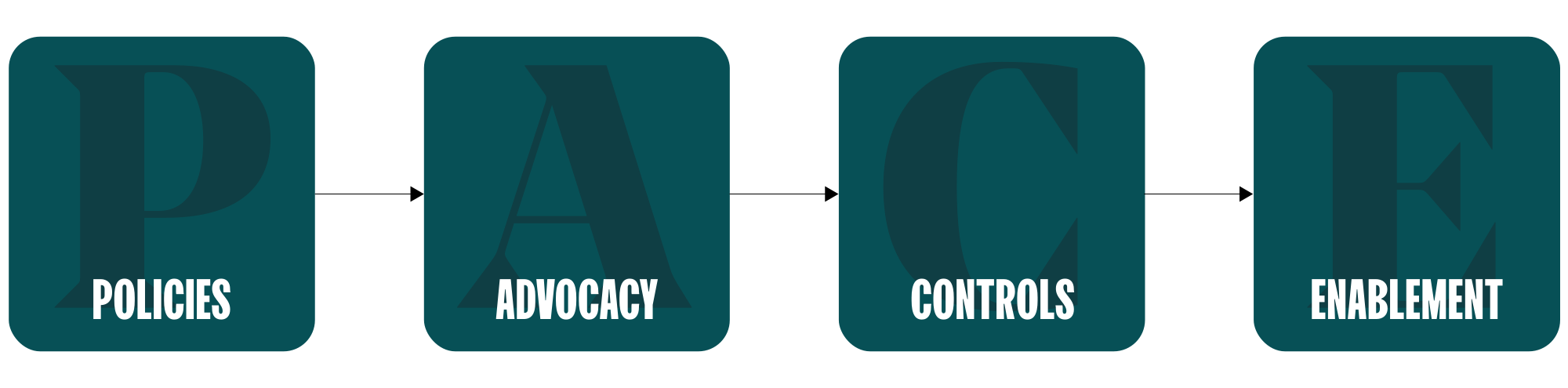
Perficient's PACE Framework (Policies, Advocacy, Controls, Enablement) is one structured approach for building that governance layer without slowing innovation to a halt.
Adobe’s AI trends research underscores the stakes: trust, transparency, and security are foundational to AI‑driven personalization, and governance gaps remain a leading barrier to scaled GenAI adoption.
Why This Matters Now:
Regulators are watching how financial institutions deploy GenAI. Getting governance wrong is not just an operational risk, it is a reputational and regulatory one.
The Bottom Line
None of these priorities are new. What separates leaders in 2026 is execution discipline: cleaner data, tighter cross-functional alignment, structured content, and AI governance that works in practice. The gap between institutions that act and those patching legacy systems will widen fast. The window to move is still open, but closing quickly. Organizations that align data, governance, and customer experience now will define the next era of financial services.
Explore how Perficient delivers solutions on Adobe Experience Cloud.