
The Real Takeaway
- AI agents are becoming a growing participant in B2B commerce, reshaping how decisions are made.
- If your product, pricing, and fulfillment data are not accessible to AI agents, you will not be considered.
- This is not about better selling. It is about being machine-readable and responsive.
Visibility increasingly depends on how well your business works for machines, not just humans.
A buyer is moving through your sales funnel right now that you can't see, can't influence, and may never speak to. It's an AI agent making procurement decisions on behalf of the executives and buying committees your sales teams spent years courting.
Here's what that looks like today in digitally mature procurement organizations. An agent receives a request for materials. It pulls supplier options, evaluates contract pricing, requests quotes, and picks a vendor on response time, compliance, and price. One supplier answers instantly through automated pricing rules. Another needs manual turnaround. The agent selects the faster option. No salesperson. No website visit. The decision closes before your traditional buying process starts.
Get skipped, and you won't know it happened.
The Shift Is Already Here
For two decades, B2B commerce leaders optimized for human buying. Better websites. Personalized digital experiences. Relationship-based sales models. These remain important.
But the buyer has changed.
As AI agents automate procurement workflows, the advantage is no longer going to companies that influence better or sell beautifully. It goes to companies that can respond faster and transact more reliably. Companies with data agents can read, systems agents can access, and pricing information they can verify without human intervention.
This is happening now in supply chain, logistics, and professional services. The first signal isn't a lost deal. It's disappearing from consideration altogether.
By the time declining conversion or pricing pressure appears in quarterly results, the pattern may already be established.
The New B2B Buying Process
Traditional B2B

Agent-Driven B2B

The supplier may never know they were evaluated and rejected.
Why Today’s B2B Commerce Model Breaks for Machines
"In the past 20 years, we built online stores for humans. They are not built for AI agents. AI agents don't understand them." — Irene Kuo, Perficient Lead, Enterprise Agentic Commerce
The mechanic is simple: AI agents don't browse. They parse, compare, and transact.
When an agent evaluates a vendor, it doesn't visit your website or read your case studies. It pulls data through structured, machine-readable channels: APIs, data feeds, procurement protocols. It compares pricing against contract terms. It validates compliance and checks inventory. It assesses response time. Then it moves on.
When pricing sits behind forms, attributes aren't standardized, inventory is inconsistent, or response times depend on manual processes, agents move on.
Most companies don't have an AI adoption problem. They have a data accessibility problem. Your product, pricing, inventory, and fulfillment data may be accurate. But if agents can't access it through structured data channels, your offerings become harder to evaluate and easier to overlook.
Speed Now Determines Winners
In B2B procurement, speed is the new differentiator.
Traditional B2B rewards relationships and trust. Agent-driven procurement rewards responsiveness, accuracy, and reliability. An agent can evaluate dozens of suppliers in seconds and prioritize the vendor that delivers complete, compliant information fastest.
Consider what happens at scale: an agent making 50 purchasing decisions per week picks fast, reliable vendors systematically. That vendor captures volume. Slower vendors, even competitors with superior products or relationships, lose share without ever knowing they were evaluated. The winner isn't the best salesperson. It's the most operationally efficient vendor.
What Breaks First
The warning signs don't show up where most companies are looking. Sales pipeline metrics stay healthy. Website traffic doesn't drop.
But several things happen simultaneously:
- Fewer opportunities reach your active deals stage.
- Win rates decline in specific categories or customer segments without a clear competitive explanation.
- Pricing pressure increases from unexpected competitors that agents can evaluate more easily.
This pattern reads as normal pipeline variation. But look closer: the gap between interest and conversion is widening. Opportunities are being eliminated before they become deals. Once this accelerates, it's too late. By then, procurement has already shifted to vendors with machine-readable systems.
Protocols Are Becoming the New Infrastructure
Protocols like the Universal Commerce Protocol (UCP) and Agentic Commerce Protocol (ACP) define how agents discover products, validate pricing, and complete transactions. They form an emerging infrastructure layer for machine-to-machine commerce, allowing agents to discover, evaluate, and transact without human intermediaries.
If you're not ready, agents can't reach your data. Other sources fill the gap, shape how you're judged, and influence how your offerings appear in agent-driven evaluations. If you're ready, agents find and evaluate you directly, pricing stays accurate, and you retain greater control over the transaction.
While standards are still evolving, they illustrate how machine-to-machine commerce is beginning to take shape.
The question isn't which protocol wins. It's whether your business is accessible to whichever ones gain adoption.
The Agent Readiness Framework
What Readiness Requires
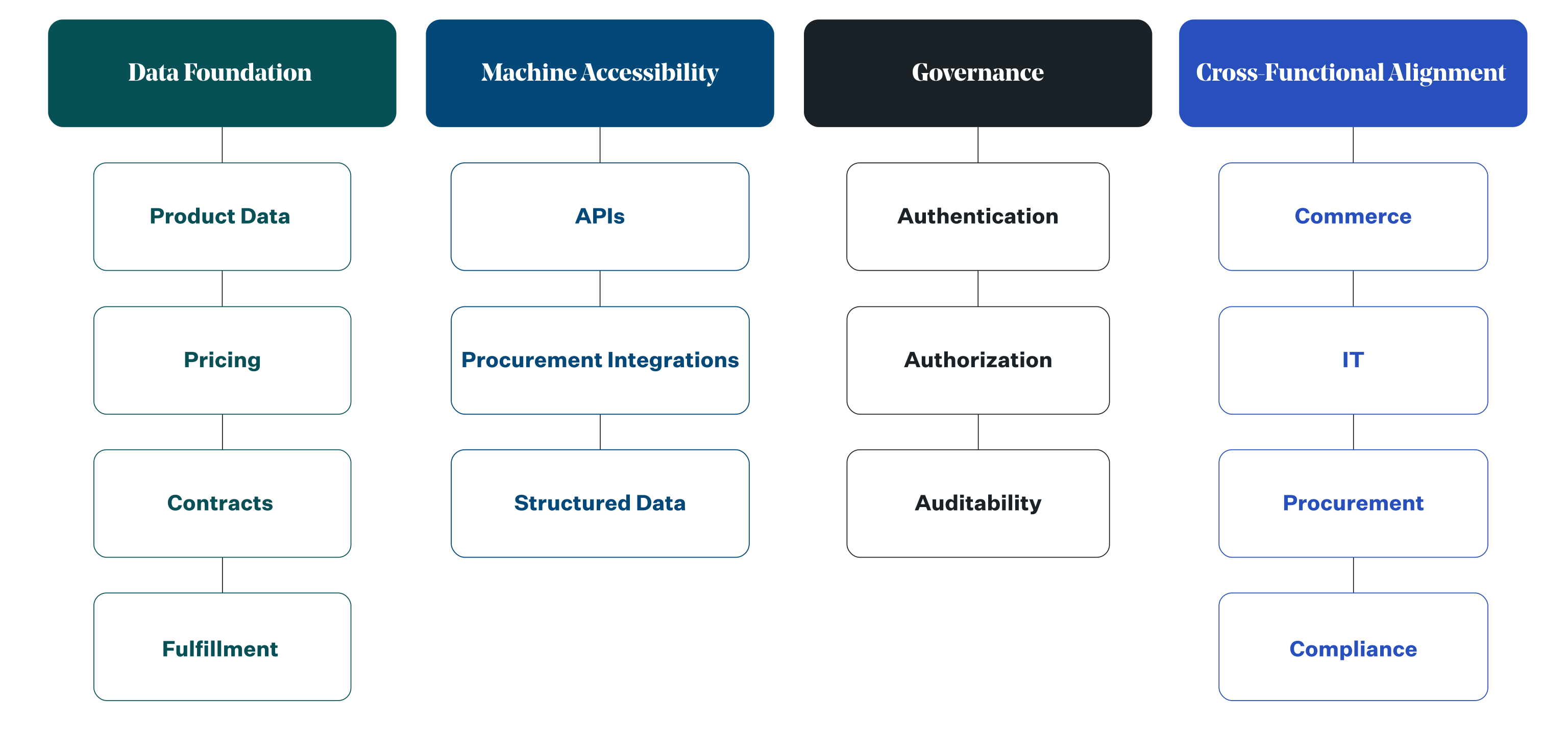
This is a business capability, not a technology project. It requires coordinated investment across four operational priorities.
- Fix Your Data Foundation. Product, service, pricing, and contract data must be consistent, accurate, and current across all systems. If your pricing lives in three different systems with three different values, agents see inconsistency and flag you as unreliable. Catalog, pricing, fulfillment, and approvals must be available through APIs. When an agent needs to validate a quote, check inventory, or confirm a compliance certification, it should get a machine-readable response in seconds, not wait for a human to process a manual request.
- Make Critical Business Functions Machine Accessible. APIs, procurement integrations, and structured data exchange should support high-value workflows such as product discovery, pricing validation, quote requests, inventory checks, and fulfillment updates. Agent-ready companies don't just expose information. They enable transactions.
- Lock Down Governance Before Scale. Without clear rules, automation creates liability. In B2B, this means delegated authentication (agents can't access data they shouldn't), defined boundaries for autonomous actions (agents can't commit to terms outside guardrails), and audit trails for accountability (every transaction is logged and traceable). Skip this and you automate your mistakes: wrong transactions, leaked sensitive pricing, and compliance exposure.
- Align Across Teams. Commerce, IT, data, and compliance all shape the outcome. The CFO cares about cost control. The CTO cares about system stability. The Chief Procurement Officer cares about vendor reliability. Align on the outcome: agents should be able to evaluate and transact with you reliably. Investment follows.
The Readiness Gap is Already Visible
Timing is a fair debate. Foundation is not. Structured data, accessible systems, and clear governance will be required regardless of which protocols win, which agents dominate, or how fast adoption spreads. The organizations building these capabilities today will be easier for agents to discover, evaluate, and prioritize tomorrow. Move early and you control how agents see you. Wait, and you adapt to how agents have already categorized you.
What To Do Now
Start:
- Audit product, pricing, contract, and fulfillment data.
- Prioritize APIs for quoting, inventory, order status, and procurement workflows.
Stop:
- Assuming customer experience alone is a sustainable differentiator.
- Treating agent readiness as an experimental AI initiative.
Accelerate:
- Data governance and quality programs.
- Cross-functional alignment between commerce, IT, procurement, and compliance.
The Invisible Buyer Doesn’t Wait
The shift is underway. As agent-driven procurement expands, visibility increasingly depends on whether machines can discover, evaluate, and transact with your business.
Companies that adapt early can influence how they're evaluated. Companies that wait will be evaluated on someone else's terms.
The risk isn't losing a deal to a competitor. It's losing consideration before the buying process officially begins and never knowing why.