

Key Takeaways
- Building software is no longer the primary challenge; deciding what deserves funding is.
- Competitive advantage increasingly comes from decision quality, not development speed.
- Evaluate SDV investments across five value lenses: customer, partner ecosystem, brand, OEM P&L, and market value.
- The strongest SDV investments create measurable value for multiple stakeholders, improving adoption, profitability, and long-term market positioning.
As Building Gets Easier, Funding Decisions Get Harder
For OEMs, the conversation around software-defined vehicles has changed.
The challenge is no longer whether software can be built. Platforms are maturing, architectures are improving, and AI-native development is reducing both the cost and time required to bring new capabilities to market. As the barriers to software development continue to fall, the focus shifts from execution to investment decisions.
OEMs are less limited by what can be developed. Instead, they’re increasingly limited by the quality of the decisions that determine where capital is allocated.
Investments are often driven by technical feasibility or competitive reaction. Code starts being written while critical questions around monetization and stakeholder alignment are left unresolved. Development proceeds, the feature ships, and only later does the organization discover that customers won’t pay for it, partners won’t support it, or the business case doesn’t scale.
The capability works, but the investment wasn’t worth it.
As software becomes easier to build, decision quality is becoming increasingly important. OEMs need a disciplined way to determine which opportunities deserve funding if they want to realize returns from SDV investments.

Evaluating What’s Worth Building: Our Five Value Framework
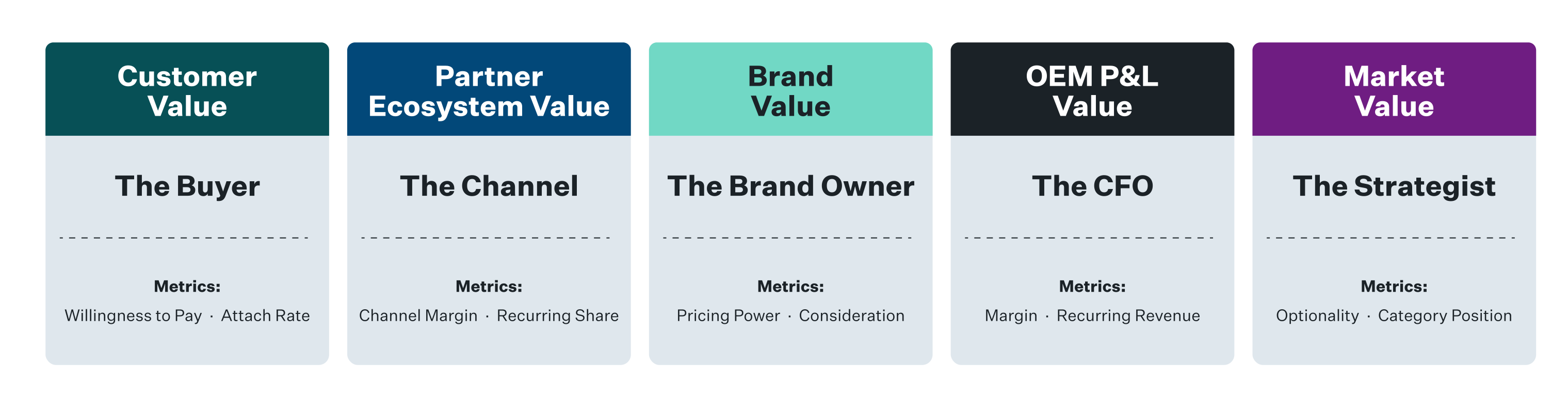
We use a structured framework to evaluate SDV investments before capital is committed. Each investment is evaluated against five value lenses:
- Customer Value: Will someone actually pay for this, directly or indirectly? This goes beyond customer interest. The question is whether the feature solves a meaningful problem, improves an outcome, or changes customer behavior. If the value proposition requires significant explanation, customer value may not be present.
- Partner Ecosystem Value: Does this strengthen the channel? Dealers, service providers, fleet operators, upfitters, and third-party partners often determine whether an SDV capability succeeds in market. When partners participate and share in value creation, adoption scales faster. When they’re bypassed, value frequently stalls.
- Brand Value: Does this strengthen differentiation? Not every capability needs to drive direct revenue. Some investments reinforce leadership, innovation perception, customer loyalty, or competitive positioning. The question is whether the investment creates meaningful distinction or simply adds another commodity feature.
- OEM P&L Value: Does this drive revenue, reduce cost, or improve margin? Value may come from new recurring revenue, improved margins, lower service costs, reduced warranty exposure, or operational efficiencies. Every investment should have a visible economic path.
- Market Value: Does this position the business for where the industry is heading? The strongest investments often create value today while building capabilities for tomorrow. This is especially important as edge AI, autonomy, connected operations, and intelligent vehicle platforms continue to evolve.
The Two-Test Rule
The framework isn’t a checklist. It’s a diagnostic that helps identify which investments are most likely to create value.
To get the green light, the investment doesn’t need a “yes” on all five questions. Our framework follows a simple rule: Every SDV investment should pass at least two value tests, and one must be tied directly to either Customer Value or OEM P&L Value.
This prevents organizations from funding initiatives based solely on competitive pressure, executive enthusiasm, technology trends, or roadmap momentum. We find this is enough to shift the conversation from “Can we build this?” to “Should we fund this at all?” Without customer value or business value, investments lack a durable foundation.
What This Looks Like in Practice
Scenario 1: Convenience Feature Subscription
An OEM introduces a subscription model for a convenience feature that is already physically installed in the vehicle. The capability functions exactly as designed. Customers can activate it on demand, pricing is straightforward, and distribution is simple. However, customers struggle to understand why they should pay recurring fees for functionality they believe they already own.
Using the framework:
- Customer Value: Weak
- Partner Ecosystem Value: Neutral
- Brand Value: Potentially negative
- OEM P&L Value: Uncertain
- Market Value: Limited
The technology may work as intended, but the investment struggles to pass the two-test rule because customer value is weak and OEM P&L value remains uncertain.
Scenario 2: Commercial Vehicle Upfitter Integration
Now consider an API-driven platform that allows third-party upfitters to integrate vehicle controls directly into commercial vehicle systems.
Using the framework:
- Customer Value: Strong
- Partner Ecosystem Value: Strong
- Brand Value: Neutral
- OEM P&L Value: Strong
- Market Value: Strong
Unlike the convenience subscription example, this investment creates value across multiple stakeholders simultaneously. Customers receive a more seamless experience, OEMs unlock new revenue opportunities, and partners gain easier integration paths.
"Every investment should be tested against the stakeholders who will ultimately create or receive the value."
Predictability Is the Advantage
A mature SDV program doesn’t rely on guesswork. Value needs to be defined before the work begins.
When investments are evaluated consistently across customers, partners, brand, business economics, and market direction, outcomes become more predictable. That starts with a testable, repeatable framework that aligns investments to where value actually exists.
As AI accelerates software development and lowers the barriers to building new capabilities, competitive advantage will increasingly come from the quality of investment decisions rather than the ability to ship features. The OEMs that define value before committing capital will be better positioned to scale SDV investments that deliver measurable returns.
To learn more about creating a value-first strategy and the opportunities we’re seeing in the SDV market, read our latest perspective.