

Key Takeaways
- Showing up everywhere isn't a strategy, it's a cost center in disguise. Presence alone doesn't create value; it creates complexity and margin pressure.
- Every channel play by different rules. Answer engines reward structured data and authority, social platforms reward engagement, and marketplaces reward fulfillment and pricing each demands its own investment.
- Economics don't transfer across channels. What works in one distributed commerce environment rarely scales the same way in another.
- Treat channels like an investment portfolio, not a checklist. Evaluate every opportunity on revenue potential, margin impact, operational complexity, and customer ownership.
- Choosing where to compete and where to walk away is the strategy, not a byproduct of it.
If you spend any time in commerce strategy discussions right now, you'll hear a familiar message: buyers are fragmenting, new channels are emerging, and brands need to show up wherever customers are making decisions.
Buyers are discovering products through social platforms. Answer engines and AI assistants are becoming part of how people research options, compare alternatives, and narrow choices.
Market Signal
According to Forrester's Distributed Commerce Strategy: Algorithms And LLMs Become Sellers (June 2026):
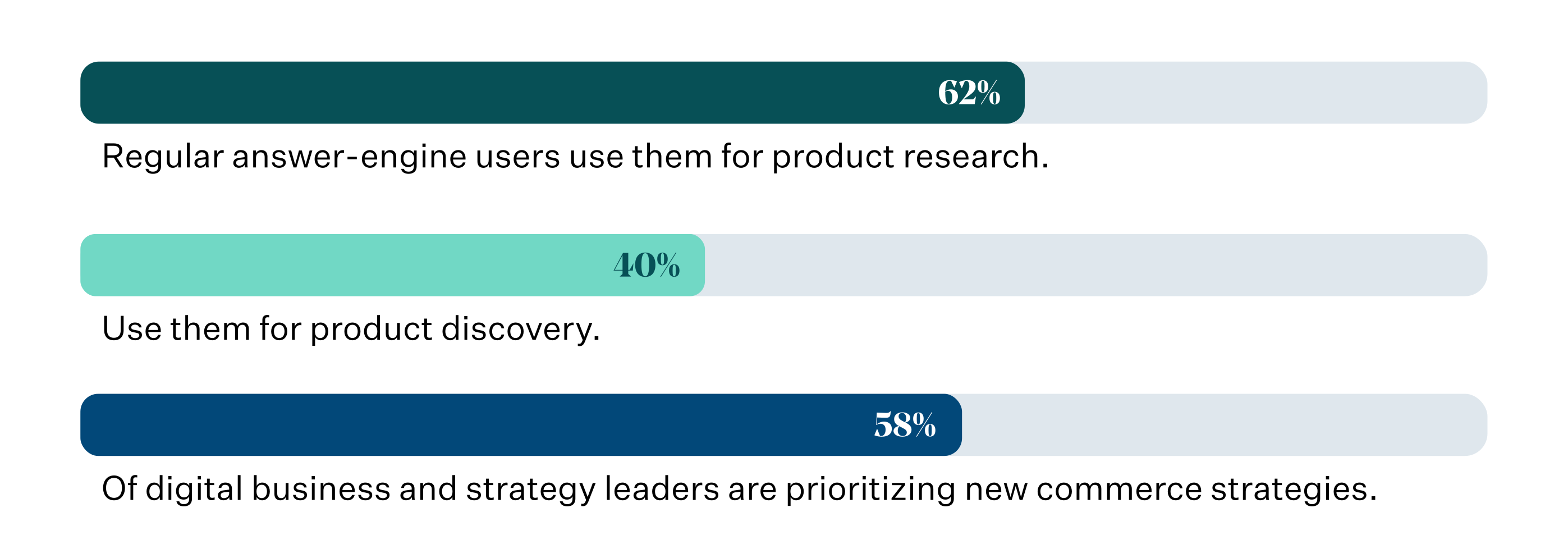
Many organizations have responded by launching pilots and expanding into new channels. The problem is that presence alone doesn't create value. In many cases, it creates cost, complexity, and margin pressure.
That's because distributed commerce isn't fundamentally a presence problem. It's a profitability problem.
Why Everyone Is Rushing In
For years, channel expansion was a reliable growth path. Add a store, launch a website, expand into a marketplace, open a new sales channel, and revenue often followed.
It's easy to see why that mindset persists.
It's easy to understand why momentum continues to build. As customers discover and evaluate products across more digital touchpoints, organizations feel increasing pressure to expand their presence beyond owned channels.
The assumption is simple: if buyers are making decisions somewhere, the business needs a presence there.
Historically, that logic worked because most new channels shared similar economics. The organization-controlled customer experience owned most of the customer data and could measure performance using relatively consistent metrics.
Distributed commerce changes that equation. The challenge isn't that buyers are making decisions in more places. The challenge is that every new intermediary changes the economics of how customers are discovered, influenced, measured, and served.
What Changed
Answer engines shape recommendations. Social algorithms determine what appears in feeds. Marketplaces influence product visibility. Connected devices can trigger purchases automatically. Increasingly, technology determines what deserves a buyer's attention before they engage directly with a brand.
One of the most significant changes in commerce is that decision-making increasingly occurs outside brand-owned environments. Algorithms, marketplaces, social platforms, connected devices, and AI-powered experiences shape what customers see long before they engage directly with a brand.
The important shift is not simply that buyers are discovering products in more places. It's that every intermediary operates according to a different set of rules. Answer engines reward authoritative content and structured product information. Social commerce rewards engagement and algorithmic relevance. Marketplaces reward fulfillment performance, pricing competitiveness, and seller ratings. As a result, distributed commerce creates multiple operating environments with different economics, data requirements, governance needs, and measures of success. Adding a channel no longer means extending reach. It often means introducing new content requirements, technology integrations, reporting models, and operational responsibilities that must be supported long after the initial launch.
Distributed Commerce Isn't One Channel. It's Multiple Business Models.
Channel | What Drives Success | Primary Tradeoff |
Answer Engines | Structured data, authority | Ongoing content/data investment |
Social Commerce | Engagement, algorithms | Platform dependence |
Marketplaces | Fulfillment, pricing, ratings | Margin pressure |
Connected Devices | Frictionless transactions | Reduced brand visibility |
Forrester's June 2026 report highlights how distributed commerce shifts more influence to third-party platforms and systems.
The Hidden Economics of Distributed Commerce
Distributed commerce is often misunderstood because many costs are not visible upfront. Meaningful participation typically requires richer product information, restructured content, stronger governance, higher data quality, and new reporting, attribution, integration, and operational capabilities. Organizations investing in AI discoverability often discover that sustainable visibility depends on high-quality product data, structured content, governance processes, measurement capabilities, and ongoing optimization efforts. Maintaining those capabilities requires continuous investment long after the initial launch.
The challenge is that these investments do not scale uniformly across channels. An organization may improve answer-engine visibility while increasing content-management costs, expand marketplace revenue while accepting lower margins or less ownership of customer relationships, or improve social commerce performance while becoming more dependent on platform algorithms it does not control. The mistake is not participating. The mistake is assuming the economics that support one channel will transfer cleanly to another.
Economics vary widely by channel. Some generate revenue but compress margins. Some require significant upfront investment. Others create operational burdens that outweigh their returns.
The challenge isn't channel proliferation. It's assuming the economics are transferable when they're not.
When Growth Starts Hurting Profitability
Distributed commerce becomes a leadership issue when organizations simultaneously fund marketplace initiatives, social commerce programs, AI pilots, regional experiments, partner ecosystems, and emerging-channel investments. Individually, each effort may appear justified. Collectively, they create a growing portfolio competing for resources, governance attention, technology support, content operations, analytics capabilities, and executive sponsorship.
Attribution and ROI remain difficult to measure across many distributed commerce environments because customer journeys increasingly span multiple platforms, partners, and algorithm-driven touchpoints. Many of these environments also limit direct visibility into customer behavior or place an intermediary between the organization and the buyer. As influence shifts toward algorithms, marketplaces, answer engines, and ecosystem partners, organizations gain reach while often sacrificing some control over discovery, customer insight, and future engagement. Without strong governance and measurement, growth initiatives can quickly become margin problems.
The Strategic Shift
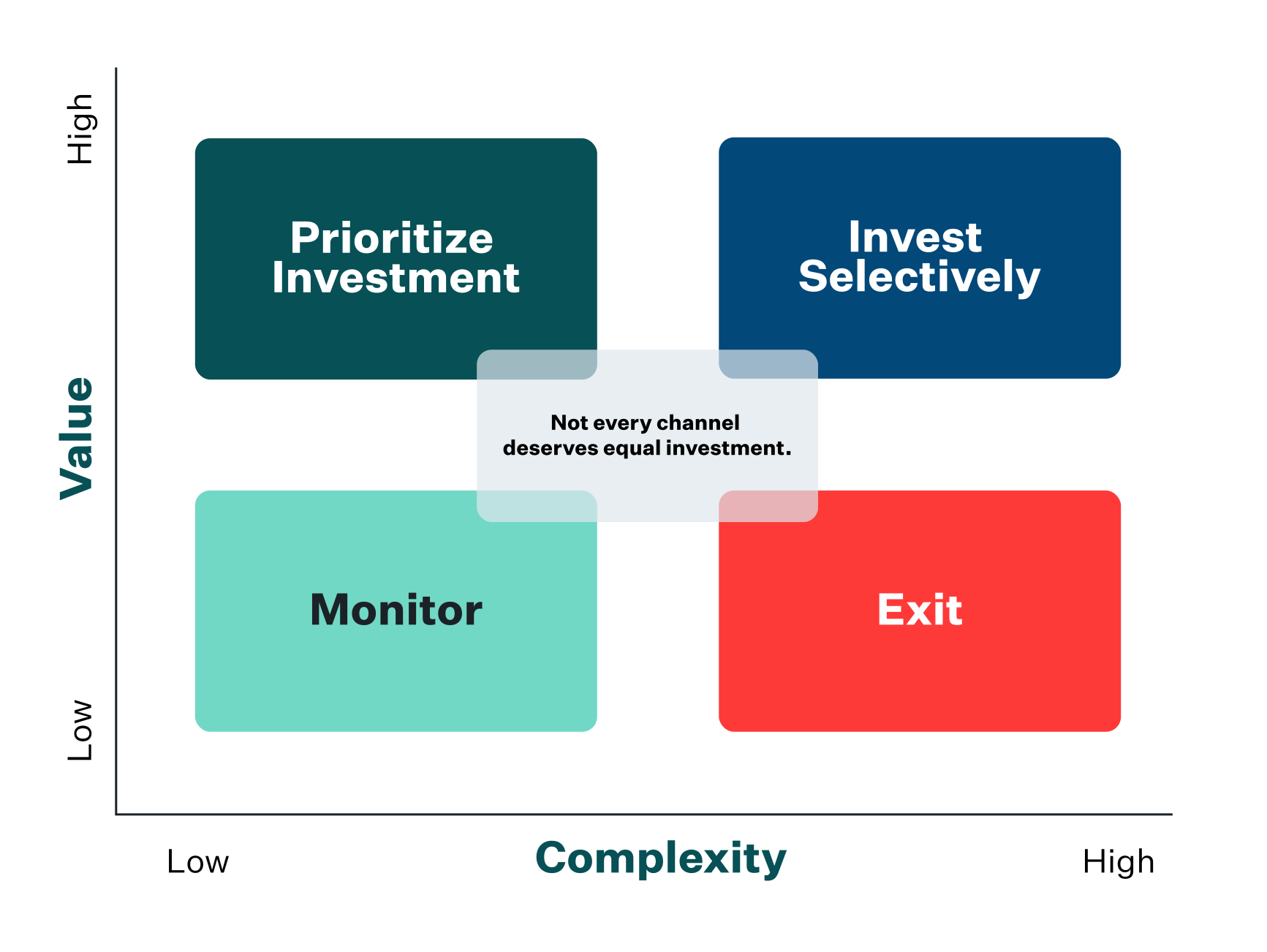
Leading organizations will manage distributed commerce as an investment portfolio rather than a channel-expansion exercise. The most effective leaders will stop asking, "How do we participate everywhere?" and start asking, "Where can we create durable economic value?"
Success will depend less on maximizing presence and more on directing investment toward opportunities that deliver measurable business value. That means evaluating channels based on returns, operational complexity, customer relevance, strategic fit, customer ownership implications, and long-term economics.
Presence becomes a result of strategy, not the strategy itself.
The Distributed Commerce Investment Portfolio
Where Leaders Should Start
Start by understanding your current distributed commerce footprint.
Many organizations are already participating through marketplace initiatives, social commerce programs, partner ecosystems, regional efforts, and emerging technology pilots.
Then evaluate each opportunity with the same rigor applied to any investment decision:
- What revenue opportunity does this channel realistically create?
- What margin impact does it introduce?
- What operational capabilities are required to sustain it?
- How much customer visibility and ownership does the organization retain?
- What governance and measurement requirements will be needed?
- Can the model scale economically over time?
Establish success criteria, decision points, and exit conditions before funding pilots.
Finally, concentrate resources where evidence supports continued investment.
The objective isn't to do less. It's to invest more precisely.
The most important lesson from distributed commerce is that participation and performance are no longer the same thing. As algorithms and AI systems play a larger role in discovery and buying decisions, leaders must look beyond visibility metrics and focus on profitability, operational readiness, governance, and ownership of the customer relationship.
Choosing is the Strategy
Algorithms and LLMs are already influencing how products, services, and suppliers are discovered, evaluated, and selected. The question is no longer whether organizations need a distributed commerce strategy. The more important question is whether leaders are making investment decisions based on economics and evidence or reacting to the fear of being left behind.
Organizations that expand without a profitability framework risk creating layers of channel complexity that never translate into meaningful business value. The winners will experiment, measure results, exit opportunities that fail to perform, and continue investing where economics support sustainable growth.
The distributed commerce race will not be won by the companies that showed up everywhere first. It will be won by the companies that know where participation generates value, where it introduces costs and complexity, and where it isn't worth the investment.
Choosing is no longer the constraint. Choosing is the strategy.
Want a Deeper Look?
Forrester's Distributed Commerce Strategy: Algorithms And LLMs Become Sellers (June 2026) provides additional research on the evolving distributed commerce landscape. Perficient was among the organizations interviewed during the research process.
Access the research - BEST PRACTICE REPORT: Distributed Commerce Strategy: Algorithms And LLMs Become Sellers.