

The Real Takeaway
- AI will not improve care quality if the underlying data is incomplete, inconsistent, or clinically irrelevant. Get the data right first.
- AI only helps when it fits inside clinician workflows, not beside them. If it adds steps or ambiguity, adoption stalls.
- Data and analytics leaders should lock down governance, interoperability, and defined clinical use cases before scaling AI programs.
Healthcare quality starts with reliable data
AI amplifies whatever it sits on. If documentation is incomplete, workflows are inconsistent, or definitions vary by service line, AI will make the noise louder. Data trust must be the first milestone, not an afterthought.
Two signals reinforce this: many organizations lack confidence in AI‑ready data practices, and programs fail when data maturity is weak. Gartner reports that 63% of organizations either do not have or are unsure they have the data management practices required for AI, and Gartner also predicts that through 2026, 60% of AI projects lacking AI‑ready data will be abandoned.
What to verify now
- Documentation completeness by measure set, for example problem lists, meds, labs, vitals, HCC evidence.
- Shared clinical definitions, one source of truth for quality rules and cohorts.
- Provenance and lineage, so clinicians and auditors can see where each data element came from.
Interoperability is a clinical requirement
Interoperability is not a compliance checkbox. It determines whether clinicians see the whole patient or fragments. Quality improvement requires a unified view that spans EHR data, claims, care management notes, imaging and lab systems, and patient-reported information. A shared data layer cuts manual review, reduces rework, and supports consistent measurement across teams.
AI will not improve care quality if the underlying data is incomplete, inconsistent, or clinically irrelevant.
Cross‑region care and growing data flows also raise governance expectations. Federal direction reinforces this: CMS’ Interoperability and Patient Access Rule requires standardized, API‑based exchange of clinical and claims data using FHIR, acknowledging that unified access is essential for high‑quality care.
This regulatory emphasis underscores why provenance, evidence capture, and runtime policy controls must be built into the platform, not left in documentation or slideware.
AI only works when it lives inside workflows
Clinicians ignore tools that sit outside daily work. If an AI suggestion forces a context switch, adds clicks, or lacks a rationale, it will be bypassed. Successful programs make AI almost invisible: they suggest documentation improvements, flag missing quality elements, surface earlier risk signals, and reduce manual chart review inside the EHR or care management tools.
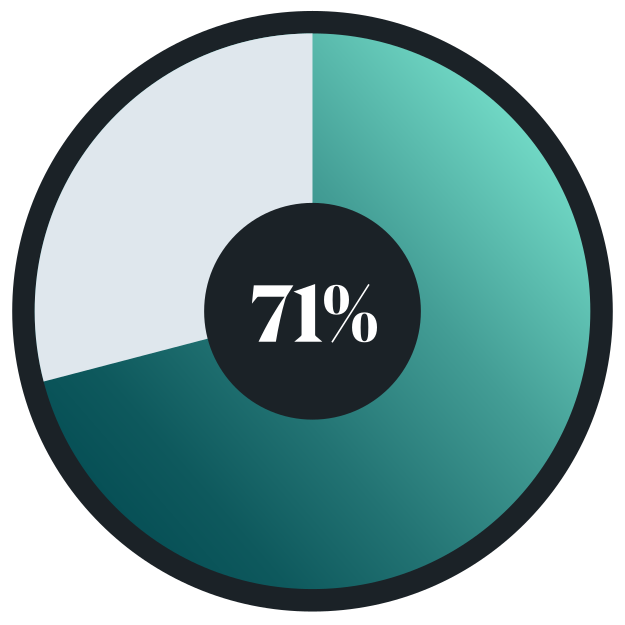
Patients and clinicians also expect clarity. Salesforce’s State of the Connected Customer research finds that 71% of people want AI outputs reviewed by a human, and trust declines significantly when AI acts alone. This reinforces that clinical AI must follow an assistive pattern with rapid human escalation, not an autonomous pattern.
Design rules
- Put AI inside the order, note, or review step where the decision happens.
- Show why a recommendation fired, inputs, and confidence.
- Keep a one‑click path to accept, edit, or escalate to a human reviewer.
Quality improvement requires operational maturity
Advanced models are not the differentiator. Consistency is. A simple model on governed data will outperform a complex one on inconsistent data.
Measure maturity by operational signals, not enthusiasm for models:
- Time to usable data, how fast yesterday’s data is available for today’s rounds and quality review.
- Definition clarity, one approved measure logic per condition, with owners.
- Input transparency, clinicians can see the fields behind a flag.
- Documentation consistency, less variation across teams for the same scenario.
- Adoption, clinicians use and trust the output, not just analysts.
Governance and controls are part of the ROI story, not overhead. Gartner’s market coverage shows rising investment momentum in AI governance platforms and increasing expectations for platform‑level evidence capture, policy enforcement, and cross‑border risk management.
These signals point to governance becoming an essential operational capability rather than a manual afterthought.
What leaders should do now
- Start with defined clinical problems. Pick high‑value gaps, for example readmission variation, sepsis recognition delays, or HCC documentation misses. State the measure, current baseline, target, and owner.
- Build a quality‑ready data layer. Integrate clinical, claims, operational, and patient‑reported data with metadata, lineage, and timeliness SLAs. Close known documentation gaps before model work. Improving data readiness significantly reduces the likelihood of project abandonment, consistent with Gartner’s findings on AI data maturity.
- Operationalize governance. Name data and measure owners. Publish definitions. Automate checks for completeness, duplication, and drift. Capture evidence for audits. Platform‑level governance improves effectiveness and reduces regulatory burden when it is part of the workflow rather than an administrative task.
- Embed AI in actual workflows. Deliver prompts and flags in the EHR and care management tools, not in standalone pilots. Provide rationale and a one‑click review path to a human. Adoption improves when clinicians can validate AI outputs, aligning with consumer expectations documented by Salesforce.
- Measure clinical impact, not activity. Track reduced variation, earlier risk identification, lower documentation burden, fewer manual reviews, and measure‑level improvement. Kill work that does not move a clinical KPI.
Operational Markers by Q4 2026
Leaders will be identifiable by four capabilities:
- Data readiness. Priority measures land in governed tables within 24 hours, with lineage and quality scores visible to all stakeholders.
- Embedded intelligence. EHR prompts cover top quality measures with clear rationale and human-validation workflows built in.
- Active governance. Policy enforcement, model inventory, and evidence capture work across teams and tools.
- Production focus. Leaders review clinical KPIs and documentation burden monthly, not model demos.
Healthcare organizations that invest in data foundations now will scale AI faster while maintaining clinical trust.
Healthcare organizations that invest in data foundations now will scale AI faster while maintaining clinical trust.
Explore how Perficient helps organizations in the Healthcare and Life Sciences industry transform their business.