

The Real Takeaway
- Intelligent Automation goes beyond RPA, bringing together AI, process mining, DPA, IDP, and emerging AI agent capabilities.
- IA addresses today’s key challenges, rising volumes, complexity, labor shortages, and financial pressures.
- Healthcare leaders are accelerating IA adoption to counter persistent workforce shortages and operational strain documented by national workforce analyses and hospital benchmarking.
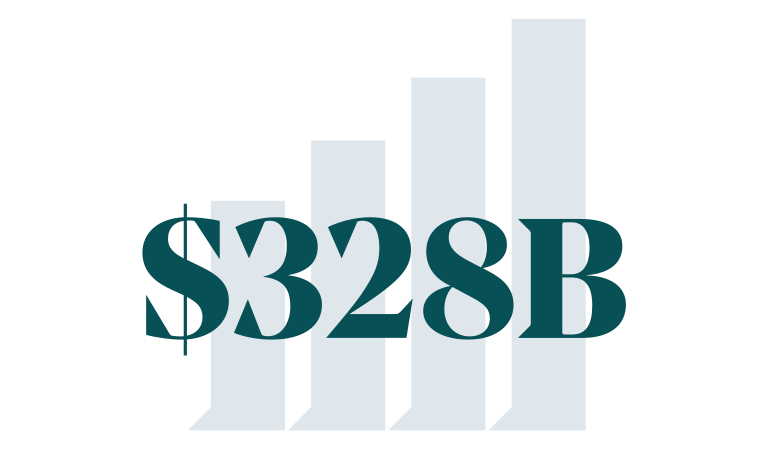
- Industry forecasts show massive impact, with IDC’s outlook projecting up to $382B in potential savings by 2027 as organizations optimize clinical, operational, and administrative workflows through intelligent automation.
- IA transforms entire workflows, from claims and enrollment to care management and supply chain.
Healthcare organizations using IA gain superior efficiency, resilience, and competitive advantage.
Healthcare organizations are facing a perfect storm: rising patient volumes, increasing care complexity, labor shortages, and unrelenting financial pressure. To stay resilient, many are turning to intelligent automation (IA)—a new generation of automation that blends AI, analytics, and workflow orchestration to modernize operations and improve decision-making.
From Legacy Automation to Intelligent Automation
For decades, automation in healthcare meant rules-based workflows, claims routing, simple task automation, or BPMN-driven process flows. These systems were rigid, code-heavy, and difficult to scale. They improved efficiency at the time but can’t keep up with today’s dynamic, interconnected environments.
Intelligent Automation represents the next evolution. Instead of relying on static rules, IA blends multiple technologies to enable real-time decisioning, adaptive workflows, and contextual understanding across clinical, operational, and administrative processes. It is not a single tool but a coordinated ecosystem of capabilities working together. IDC’s market work describes this shift from single‑tool automation to an AI‑infused, platform approach that unifies labor‑, system‑, and decision‑centric layers.
The Core Components of Intelligent Automation
Organizations often equate “automation” with RPA, but IA goes far beyond task bots. True IA sits at the intersection of process mining, digital process automation (DPA), RPA, and AI, including AI agents that support contextual decision‑making. IDC frames this as intelligent healthcare provider automation that embeds AI and automation into end‑to‑end workflows for measurable financial and clinical outcomes.
Key components include:
- RPA and APA (Agentic Process Automation): Traditional RPA handles repetitive tasks, while APA introduces contextual awareness and recommended actions.
- GenAI-Enabled Process Discovery: Generative AI reimagines legacy workflows, identifies opportunities for transformation, and accelerates redesign.
- AI Agents: Emerging agent capabilities that can analyze data, recommend next steps, and operate inside workflows.
- Case Management: Tools that move complex work across defined stages, ensuring transparency and traceability.
- Intelligent Document Processing (IDP): Automated extraction, classification, and validation of unstructured data such as faxes, claims, and clinical attachments. Hyland and IDC highlight how IDP and content intelligence unlock value from unstructured clinical content, which can represent the majority of a health system’s information footprint.
- Low-Code/No-Code Platforms: Enabling rapid solution development without heavy engineering cycles.
Together, these components create a scalable automation fabric that improves quality, reduces costs, and enhances both patient and workforce experiences.
Why Intelligent Automation Is Becoming Essential
Legacy systems can’t support the agility needed for modern technology transformation. Healthcare leaders are accelerating IA adoption because it delivers measurable gains in productivity, accuracy, and throughput, and the momentum is backed by industry and regulatory signals.
IDC’s healthcare FutureScape projects up to $382B in savings by 2027 from intelligent automation, reflecting impact across clinical, operational, and administrative workflows. At the same time, national workforce projections and hospital benchmarking continue to document widening clinician shortfalls and sustained labor pressures, which make workflow automation and augmentation a strategic necessity rather than a convenience.
Healthcare organizations increasingly view automation not merely as a cost‑savings lever but as a strategic enabler of operational resilience, improved care experiences, and competitive differentiation.
How Intelligent Automation Is Already Transforming Healthcare
IA is already improving outcomes and streamlining workflows across patients, providers, payers, and operations. Examples include:
Conversational AI
- Contextual search across documents
- Automated case summaries
- Comparative analysis for clinical or administrative files
Document Triage and Processing
- Omnichannel intake
- Automated classification, data extraction, and validation
- GenAI enhanced review for speed and accuracy that reduces manual work and accelerates information flow to clinicians
Patient & Provider Operations
- Enrollment, eligibility verification, and benefit explanation
- Prior authorization support aligned to API‑first, FHIR‑based interoperability rules that are phasing in across payers
- Provider credentialing and lifecycle management
Pharmacy & Supply Chain
- Automated prescription workflows
- Inventory optimization
- AI-driven demand forecasting and supply chain disruption management
Clinical and Care Management
- Utilization management
- Case workflow optimization
- Value-based care analytics and decision support
Claims Processing
- Automation from claim ingestion through adjudication and audits
- Outreach to members and providers
- Coordination of benefits and Medicare processes
Enrollment
- End-to-end automation across all submission channels
These use cases demonstrate that IA is shifting healthcare from incremental productivity improvements to end‑to‑end workflow optimization, consistent with IDC’s outlook for intelligent automation’s role in provider and payer operations.
Building Intelligent Healthcare with the Right Partner
Perficient helps healthcare organizations modernize operations and achieve measurable value from IA by combining strategic guidance, proven frameworks, and deep technical expertise.
Our strengths include:
- Business Transformation: Strategy activation for long-term health system and payer growth.
- Modernization: Modern tech architectures that promote interoperability and scalability. Program roadmaps increasingly anchor to CMS‑aligned, FHIR‑based APIs for patient access, prior authorization, and payer‑to‑payer exchange, which reduces friction and improves data liquidity for downstream automation.
- Data & Analytics: Insights-driven decision support and enterprise agility. Gartner cautions that without AI‑ready data practices, organizations risk abandoning a majority of AI projects, reinforcing why data quality, provenance, and governance must be embedded into IA programs.
- Consumer Experience: Frictionless, intuitive patient and provider journeys.
Healthcare organizations that combine automation, AI, and modern platforms will unlock the efficiency needed to meet rising care demands.
Explore how Perficient helps organizations in the Healthcare and Life Sciences industry transform their business.