

The Real Takeaway
Manufacturers have spent years investing in customer experience. Most of that investment is being undermined by the same problem: product data that is inaccurate, inconsistent, or disconnected from real inventory.
The extended enterprise, meaning the full network of distributors, dealers, partners, and direct buyers, cannot deliver a reliable experience if the underlying data infrastructure is broken.
Fixing this is not a CX initiative. It is a systems and integration problem.
The Real Barrier Is Internal
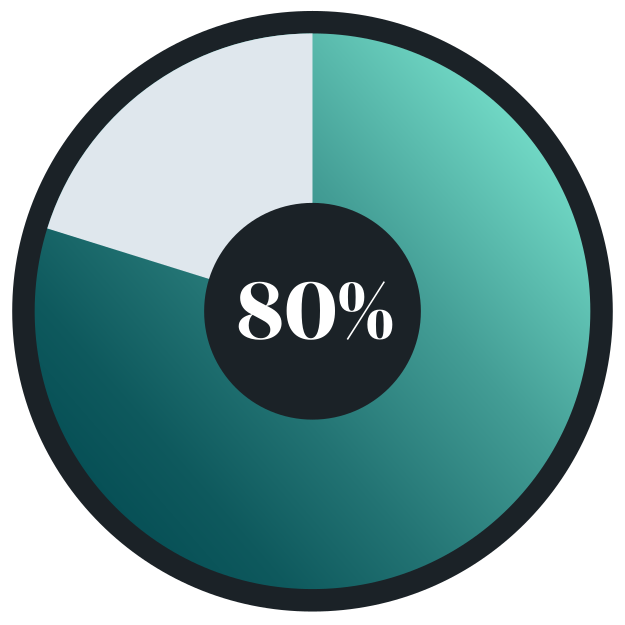
Most manufacturers understand that customer experience matters. In fact, 80% of B2B buyers now expect the same buying experience as B2C customers, according to Lumoa research. That means clarity, speed, and accuracy on par with consumer channels - and little patience for product pages with missing specifications, portals showing inventory that does not exist, or lead times that contradict what a sales rep says on the phone.
What manufacturers underestimate is how much of that friction is internal. The issue is rarely the digital channel. It is the data behind it.
Product content is fragmented across systems. Specifications live in PLM. Descriptions sit in a CMS. Pricing is in ERP. Availability data, when it exists, is pulled from a warehouse system on a lag. None of these connect in a way that produces a coherent, accurate experience for the buyer.
The issue is rarely the digital channel. It is the data behind it.
The result: buyers cannot confirm stock, cannot get accurate lead times, and either abandon the transaction or call a rep to verify what the website should have told them. That call costs money. That abandonment costs revenue. Neither problem gets solved by redesigning the front end.
Three Things That Have to Work Together
The extended enterprise, distributors, dealers, channel partners, and direct buyers, each have different data needs and system environments. Serving all of them from a single, accurate source of product truth requires three things to work together.
Integrated systems, not connected silos. PLM, PIM, and OMS are treated as separate domains with separate owners. In practice, the customer experience depends on all three: PLM holds the product record, PIM structures and enriches it for commerce, OMS ties availability to what is promised at the point of sale. When these are not integrated, every downstream channel operates on incomplete information.
Accurate availability, not approximate availability. Available-to-promise data is one of the most consequential inputs in a manufacturing transaction and one of the most frequently wrong. When ATP and lead times are inaccurate online, buyers lose confidence in the brand, not just the website. Connecting real-time inventory and fulfillment logic to customer-facing systems closes that gap: fewer lost orders, fewer support calls, higher buyer confidence.
Content that works across every channel. Product content must be technically accurate for an engineer, commercially clear for procurement, and localized for different markets, and it must be consistent whether it appears on the manufacturer's portal, a distributor's catalog, or a marketplace. A governed PIM is the only practical way to maintain that consistency at scale. Without it, every partner maintains their own version, and version drift creates exactly the trust problems that undermine the buying experience.
Where AI Fits, and Where It Does Not
Generative AI has real applications here: enriching product descriptions at scale, generating localized content, powering search and recommendations, supporting agents on complex queries. These are legitimate gains.
But AI applied to bad data produces bad output faster. Manufacturers that have used generative AI for product content without first establishing clean, governed data as the input have found the results inconsistent, sometimes inaccurate enough to require manual remediation. That is not a failure of AI. It is a sequencing problem.
AI applied to bad data produces bad output faster. The sequencing matters.
Fix the data foundation first. Establish integration and governance. Then apply AI to scale what the foundation produces. Agentic architectures, where models validate each other's outputs and flag for human review before content reaches the customer, add a meaningful quality layer, but only when the underlying data is already reliable.
Maturity Has a Logical Sequence
The foundation is centralized content management: a single, governed source of product truth. Without it, every downstream initiative fights the same data quality problems repeatedly.
The intermediate stage is integration: PLM, PIM, and OMS working together with clear ownership across business units. This is where most manufacturers struggle. The systems exist. The integration often does not.
The advanced stage is personalization: using behavioral data and AI to serve different content to different audiences from the same underlying product record. That is achievable. It is not the starting point. It is the result of getting the foundation right.
DIAGNOSTIC: Where Is Your Organization?
- Do all customer-facing channels draw from a single, governed source of product content?
- Is ATP data connected to what buyers see online, and is it accurate in real time?
- Are PLM, PIM, and OMS integrated with clear data ownership across business units?
- Can you distribute accurate, localized content consistently to all channel partners?
- Are you applying AI to enrich governed data, or compensating for the absence of it?
The Foundation Comes First
Manufacturing CX is a data infrastructure problem disguised as a marketing challenge. Organizations competing effectively make product content, availability, and integration systems-level priorities. The extended enterprise is complex. The path forward is straightforward: establish a governed foundation, integrate core systems, then scale with intelligence. Manufacturers that skip the foundation will keep rebuilding on broken plumbing.
Explore how Perficient helps organizations in the Automotive and Industrial Manufacturing industry transform their business.