

The Real Takeaway
- FinOps needs to move beyond cloud cost tracking and expand to “Cloud+,” including SaaS, data platforms, AI, observability, and container spend. This shift is reflected in the FinOps Foundation’s 2025 Framework, which formalizes Cloud+ via new “Scopes” that include public cloud, SaaS, and data center spending.
- Unit economics is the maturity step, shifting the conversation from total spend to cost per transaction, customer, workload, or outcome.
- When Finance, Engineering, and Product work from these shared unit metrics, organizations manage margin and value creation, not just expenses. This cross‑functional model is embedded in the FinOps Framework and its Quantify Business Value domain.
Applying FinOps concepts to your cloud consumption is not new. It’s often treated as an IT hygiene task, necessary but not strategic. And while cost optimization and waste reduction are worthy efforts, it’s all too common to see these activities fall victim to higher daily priorities. When they are in focus, it’s often attempted by looking for low-hanging wins using cloud-native services that aren’t overly interested in delivering a comprehensive picture of cloud spend. It’s just one of those activities that is hard to get too excited about.
I challenge us to reboot this thinking with a fresh, outcome-focused perspective:
First, let’s expand FinOps to consider the bigger picture of technology spending.
The FinOps Foundation describes this as the “Cloud+” era and codifies through Scopes in the 2025 Framework and State of FinOps 2025 report. Practices are increasingly applying FinOps to SaaS, licensing, and even private cloud and data centers, not just public cloud.
Complexity is increasing, multicloud and hybrid environments are the norm. Real technology spend includes observability tools, containers, data platforms, SaaS licensing, AI/ML, and peripheral services, sometimes hand-waved away as shadow IT or just life as part of an unavoidable cost center. The more we can pull in these broader costs, the more accurate our insight into technology investments. Which leads us to…
Second, let’s start thinking about Unit Economics.
This is a challenge, and only a small percentage of organizations fully get there, but the business payoff in shifting to this mindset can bring immediate business performance results, well beyond just optimizing public cloud infrastructure. Unit economics connects spend to value in business terms, such as cost per customer or per transaction, enabling better pricing and product decisions.
The story we need to tell in FinOps isn’t “How much are we spending?”, it’s whether we are generating value from our investments and understanding the impact on revenue and margin if cost drivers change. Let’s make sure every dollar spent is a good dollar aligned to business objectives.
Controlling costs is necessary. Maximizing value is strategic.
Measuring What Matters
Unit Economics shifts the focus from tracking aggregate cloud spend to measuring value at the most meaningful level, per transaction, per customer, per workload, or per outcome.
These metrics bridge the gap between cloud consumption and business impact, aligning technology decisions with revenue, profitability, customer experience, and other key performance indicators.
Unlike traditional IT financials, unit economic metrics are built to reflect how your business actually operates. They unify Finance, Engineering, and Product teams around shared goals, fostering a mindset where cost efficiency and value creation go hand in hand.
When used effectively, these metrics inform everything from financial forecasting, product planning, digital strategy, M&A onboarding, and feature delivery, turning cloud from a cost center into a competitive advantage.
Asking the Right Questions
Establishing effective unit economics begins with curiosity, a willingness to think differently, and meaningful collaboration. Consider these exploratory questions:
- Do we have the right visibility into our overall technical spend?
- Does it feel like there has to be a better way to do this?
- How mature are our tagging, cost allocation, and mapping practices?
- Can we define measures that reflect our company’s business performance goals?
- Are Finance, Product, and Engineering collaborating on goals, reporting, and forecasting?
- Do we have the right tools to build a complete picture of technology value as we scale?
From Cost to Value: The Unit Economics Flow
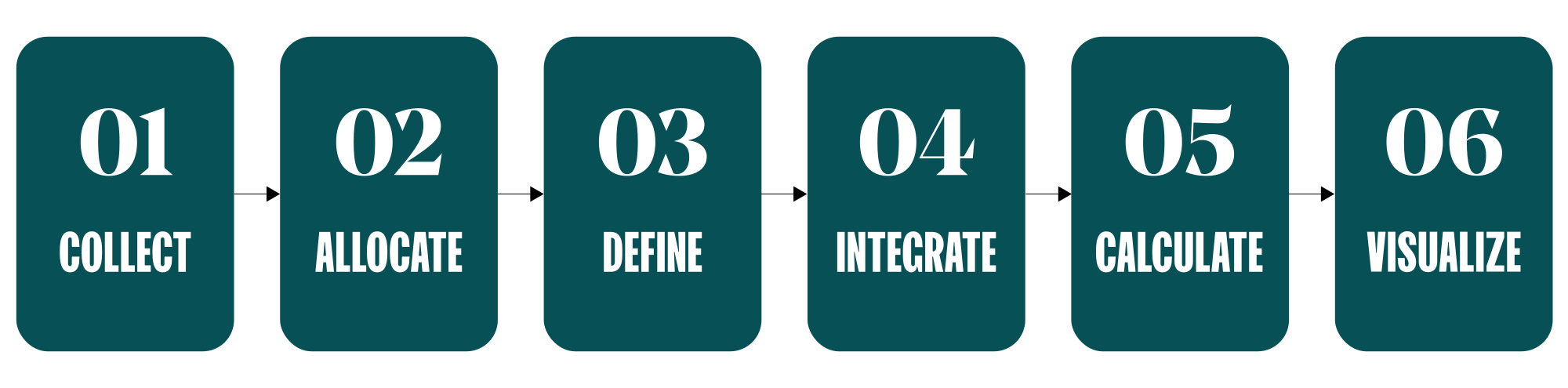
To put unit economics into action, organizations can follow this basic flow:
- Collect cloud and technology cost data across hybrid infrastructure, marketing, SaaS, and 3rd party tools
- Allocate costs to business segments such as products, BU teams, or delivered services
- Define units of value that reflect relevant and meaningful business outcomes
- Integrate with business systems to leverage financial, sales & marketing, labor, and performance metrics
- Calculate and normalize unit metrics across products, departments, and regions
- Visualize, monitor, and act through dashboards, forecasts, and optimization reviews
This approach is a baseline for moving towards more informed decisions and the potential impact of future investments.
Maturing Unit Economics with Apptio Cloudability Intelligence
Technology alone doesn’t solve this challenge, but the right platform accelerates the journey. We leverage Apptio Cloudability to bring at-scale intelligence and automation to financial operating models.
With Cloudability, our clients can:
- Automate cost allocation using advanced tagging, showback, and chargeback models
- Visualize unit cost metrics by product, application, or team
- Simplify visibility into multicloud and container-based environments
- Forecast spend using trends and usage patterns tied to real business activity
- Detect cost anomalies and surface optimization recommendations
- Track and benchmark progress on key metrics like Cost per Customer or Revenue per Technology Dollar
Why This Matters Now
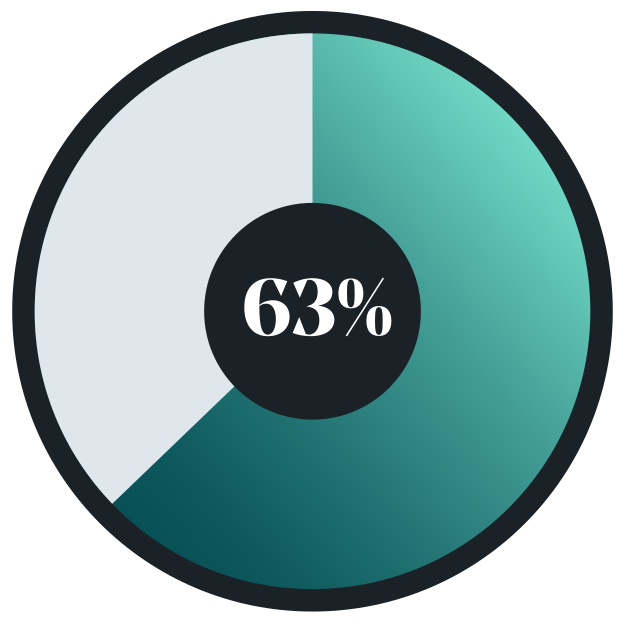
IDC forecasts financial services as a top AI investor through 2028. Gartner warns that 63% of enterprises lack data practices to support those investments, predicting widespread AI initiative failure. The gap between spending and readiness is widening.
FinOps provides the connective tissue between technology investment and business value. Organizations that embed FinOps into operating models will turn cloud spending into competitive advantage. Those treating it as reactive cost control will keep funding experiments that don't deliver.
Explore how Perficient delivers AI-First Cloud Modernization solutions.