

The Real Takeaway
Utilities already have the AMI data they need. The challenge is activating it.
AMI delivers limited value when data is siloed within meter operations. It delivers transformational ROI when that data is operationalized across the organization. Utilities that operationalize AMI data turn isolated signals into enterprise-wide action. Those that don’t remain stuck extracting only partial value.
Turn Missed Signals Into Operational Intelligence
A cluster of meters stops communicating.
It could indicate a communication failure, a voltage irregularity, or broader grid activity. In many utilities, this signal rarely makes it beyond meter operations. It remains siloed in the MDMS to be reviewed later or missed entirely, disconnected from the teams that could act on it.
But when AMI data is integrated and operationalized, that same signal becomes visible across systems. It's surfaced in shared tools, where teams can respond in real time.
Strengthening Meter Network Reliability
That signal, from meters going quiet, is often not a meter issue. The problem may be the surrounding network: how meters connect to field area routers and how those routers connect to cellular infrastructure. Without visibility into this full path, it’s difficult to pinpoint the failure.
By mapping the relationships between meters, routers, and cell towers, utilities can see where meters are dropping off the network, ensure meters are connected to the correct routers and communication paths, and detect coverage gaps or routing issues impacting data flow.
With better visibility, utilities can resolve communication failures faster and maintain a more reliable data flow to downstream systems. The missing signal becomes a diagnosable network issue.
Outage Response Without the Guesswork
In a connected environment, that same signal flows into outage response. Here, integrated views combine AMI, OMS, and GIS data, allowing teams to see real-time, meter-level activity.
Now, outage teams can begin to:
- Identify the likely scope of the disruption
- Define outage boundaries
- Validate restoration through meter signals, not manual checks
There is less reliance on customer calls to validate an issue, so teams begin diagnosing earlier. This shortens discovery time, accelerates restoration, and improves reliability metrics.
"The goal isn’t just to respond to issues. It’s to understand what’s happening early enough to act before the customer ever needs to call.”
Field Crews Are Dispatched with Context
That same signal informs field operations. Instead of dispatching crews with limited information, intelligence is embedded directly in dispatch and mobile workforce tools. Work orders are enriched with AMI data — meter location and status, indicators of a likely issue or potential root cause, and context from surrounding grid activity — along with inventory and ERP inputs such as required tools, parts, and safety considerations. Tickets are also grouped geographically.
Crews arrive with a clearer understanding of the issue before stepping on-site. This turns a “go investigate” scenario into a targeted response that reduces truck rolls, speeds resolution, and improves efficiency.
Customer Service Shifts From Reactive to Real-Time
At the same time, that signal reaches customer-facing teams. Real-time meter and outage status appears directly within the agent desktop, alongside billing and account information.
This allows agents to:
- View meter communication and outage status in one place
- Provide accurate updates based on real-time data
- Trigger outbound notifications tied to actual events
AMI data also helps explain billing anomalies. For example, usage spikes tied to weather events can be identified in advance, allowing utilities to anticipate customer inquiries and respond proactively. Instead of reacting to frustration, teams can get ahead of it to reduce call volumes and improve customer satisfaction.
From Event to Predictive Insight
Over time, signals like these reveal patterns. Voltage fluctuations, intermittent outages, and communication degradation expose underlying risks across the grid.
When AMI data is integrated with asset and geospatial data, those patterns are surfaced through dashboards, alerts, and prioritized work queues. Circuits showing repeated anomalies are flagged for inspection. At-risk assets are prioritized before failures occur. Vegetation-related disruptions are identified based on actual grid behavior.
The same signal that once indicated a single issue now informs predictive, condition-based planning, reducing outage frequency and improving resource allocation.
“Meter data is no longer confined to a single function. It sits at the intersection of operations, outage response, vegetation management, and customer experience.”
One Dataset. Every Team. Real-Time Intelligence.
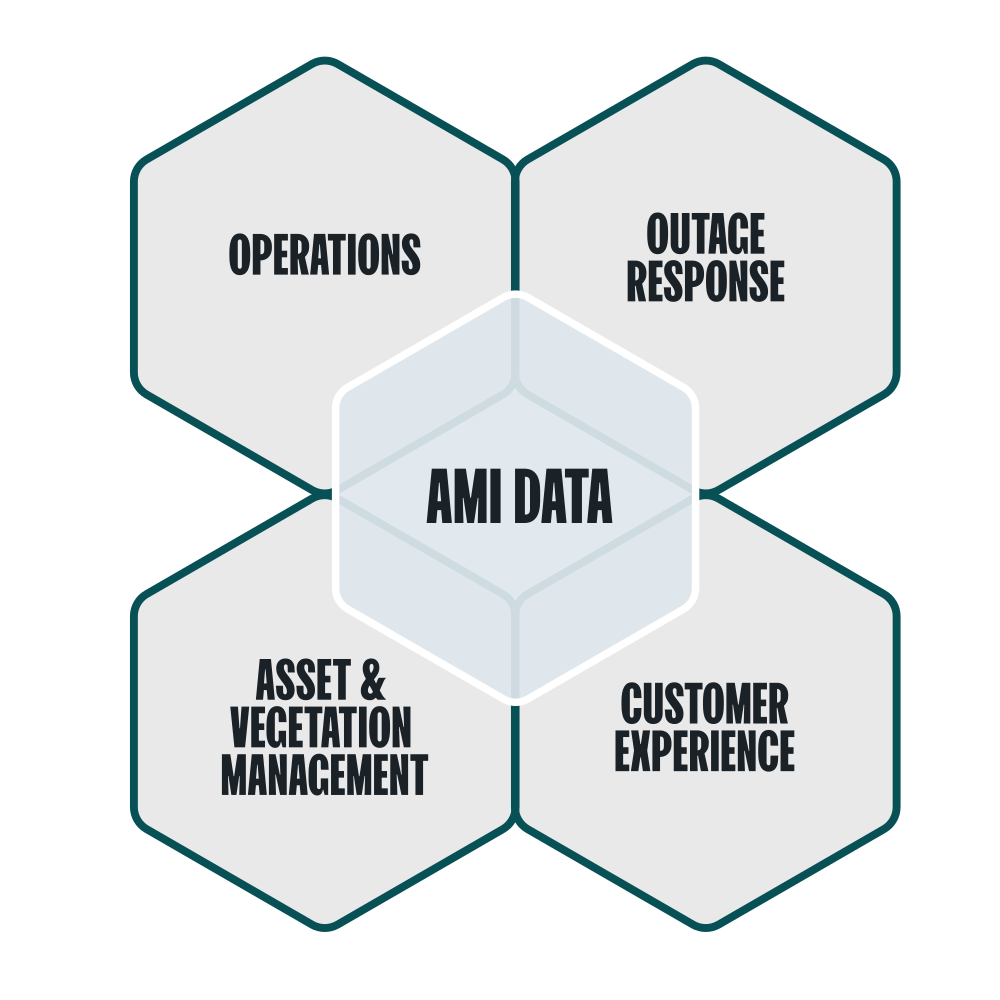
Across every team, no new data is created. It is only shared.
The same AMI telemetry is used across:
- Meter operations
- Outage response
- Field operations and dispatch
- Customer service
- Maintenance, asset, and vegetation management
When AMI data flows reliably and in real time to every function, it enables better coordination and faster decisions. Yet most utilities haven’t operationalized AMI data. Despite widespread deployment of smart meters, more than 60 percent of utilities still use meter data primarily for billing and basic outage alerts, according to EPRI.
The Gap Isn’t Data. It’s Action.
Utilities already have the foundation. AMI systems are deployed, and telemetry is flowing. The gap is between data that is collected and data that is operationalized. Closing that gap requires connecting AMI data across systems and workflows. That means moving from siloed environments to a unified, real-time data foundation that integrates AMI with OMS, GIS, and customer platforms.
Operationalization is the capability that separates partial value from transformational ROI. When every team works from the same signal at the same time, with the context needed to act, operational intelligence becomes part of how the utility runs.
Learn more about how Perficient integrates and activates AMI data for real ROI.