

Marketing technology has exploded from a niche category into an ecosystem of more than 14,000 solutions. Scott Brinker, VP of Platform Ecosystem at HubSpot and editor of ChiefMartec.com, joined Perficient to unpack how marketing leaders can navigate this increasingly complex environment and why the role of marketing continues to evolve.
Here are the insights every MarTech leader should understand.
1. Marketing Has Changed More Than Any Other Profession
According to Brinker, few professions have expanded in scope as dramatically as marketing.
Marketers are now responsible for a wide range of disciplines. These include brand, digital channels, customer experience, automation, analytics, and coordination with sales and service teams. The challenge is that none of the original responsibilities disappeared. The load simply increased.
Brinker puts it plainly:
"I would be hard pressed to find another profession that has had as much change in scope creep as marketing."
As a result, marketing leaders must manage far more complexity while still delivering growth.
2. The Martech Paradox: Consolidation and Expansion at the Same Time
The MarTech landscape grew from roughly 150 tools in 2011 to more than 14,000 today. This expansion defies predictions that consolidation would simplify the ecosystem. Instead, both consolidation and proliferation are happening simultaneously.
Large platforms such as Adobe, Oracle, Salesforce, and HubSpot continue to acquire and unify solutions. Meanwhile, thousands of specialized tools thrive in the long tail. The result is an ecosystem where leaders must balance stable core platforms with specialized integrations.
Brinker’s advice:
Choose platforms with strong integration capabilities, then add specialized tools only where they meaningfully improve customer experience or workflow.
3. The Data Layer Is Reshaping Everything
Customer Data Platforms (CDPs) emerged to solve fragmentation across tools. But cloud data warehouses such as Snowflake and Databricks are shifting this conversation. Organizations increasingly centralize data in the cloud, raising questions about whether a separate CDP is still necessary.
However, centralizing data does not eliminate challenges. It introduces new ones around governance, organization, data quality, and orchestration. Brinker notes that some vendors now position themselves as composable CDPs, sitting on top of the warehouse and orchestrating data activation.
This shift signals a larger trend. The future of MarTech will be defined less by the tools themselves and more by how organizations architect and govern their data foundation.
4. Bridging the Technology-Adoption Gap
Brinker describes MarTech’s Law:
Technology advances exponentially, but organizations change logarithmically.
This mismatch creates a widening gap between what technology can do and what organizations can successfully implement. Even highly capable teams struggle to keep up with the pace of change.
As a result, many MarTech investments are underutilized not because the tools are inadequate, but because people and processes lag behind.
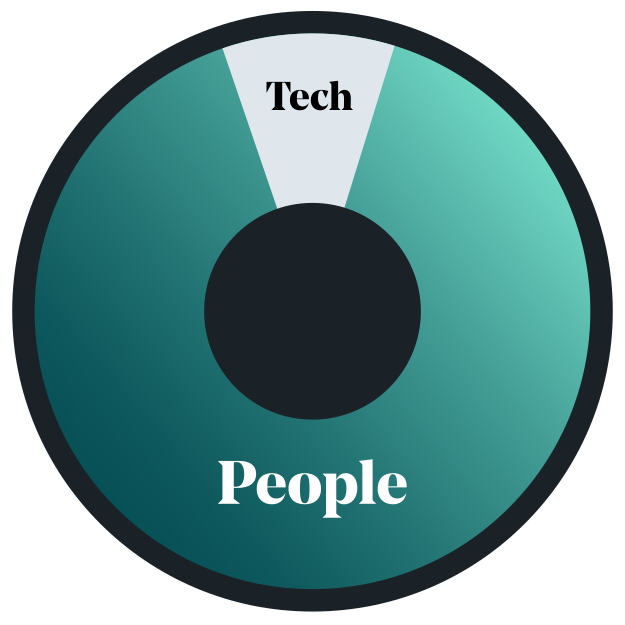
5. The 90/10 Rule: Invest in People, Not Just Technology
Brinker highlights a core principle for navigating today’s MarTech landscape:
For every dollar spent on technology, leaders should spend nine dollars on people and enablement.
This investment goes beyond formal training. It requires:
- creating space for experimentation
- encouraging hands-on learning
- supporting curiosity
- embedding exploration time into workflows
- helping teams understand contextual use cases unique to their business
Brinker’s call to action: stop reading about new tools and start playing with them. Hands‑on exploration is the only way to understand how rapidly evolving platforms truly work.
The Bottom Line
Scott Brinker’s message is clear. The MarTech landscape will continue expanding and consolidating at the same time. Data will remain both an opportunity and a challenge. And the technology itself will always move faster than the organizations trying to use it.
Leaders who win will:
- invest in people more than platforms
- build stacks with strong integration cores
- experiment quickly
- focus on data governance and orchestration
- adopt tools through learning, not theory
Marketing leaders who invest in people, data governance, and experimentation will be best positioned to navigate the ever-expanding MarTech landscape.
Explore how Perficient delivers AI-First Marketing solutions.
These insights are drawn from Scott Brinker’s appearance on Perficient’s What If? So What? podcast.