

Chris Duffey, Head of AI Platforms & Systems at Adobe, brings more than 25 years of experience shaping digital experiences and a front-row seat to one of the most significant shifts in marketing and enterprise technology in a generation. In a recent conversation with Perficient, Duffey explored how Generative AI is reshaping not just how organizations produce content, but how they operate, compete, and create value from the inside out.
1. The CMO Is Becoming the Central Source of Business Intelligence
Duffey challenges the notion that marketing is a downstream function, one that receives strategy and executes it. In his view, Generative AI and Agentic AI are repositioning the marketing function as the nerve center of the enterprise.
"The CMO, the marketer, is going to be the central source of truth for a business... it is now going to house all of the insights."
By closing the loop between content creation, market performance, and real-time data, marketing leaders gain the ability to inform product development, sales cycles, and broader business strategy, not just campaigns.
Why it matters: Gartner research consistently identifies data-driven decision-making as a top CMO priority. As AI compresses the feedback loop between marketplace activity and organizational response, the marketing function stands to gain strategic influence well beyond its traditional scope.
2. AI Adoption Has Matured From Experimentation to Enterprise Vision
The early days of "bolting AI onto existing workflows" are over. Duffey notes that enterprise conversations have shifted dramatically, from pilots to long-range transformation planning.
"What we've seen over the last 12 months or so is the need to map out a three-to-five-year AI vision and then reverse engineer to get to that vision across all aspects and layers of a business."
Organizations are no longer asking whether to adopt AI. They're asking how to architect their entire operating model around it. Duffey's word for this shift is telling: he no longer calls it transformation. He calls it reinvention.
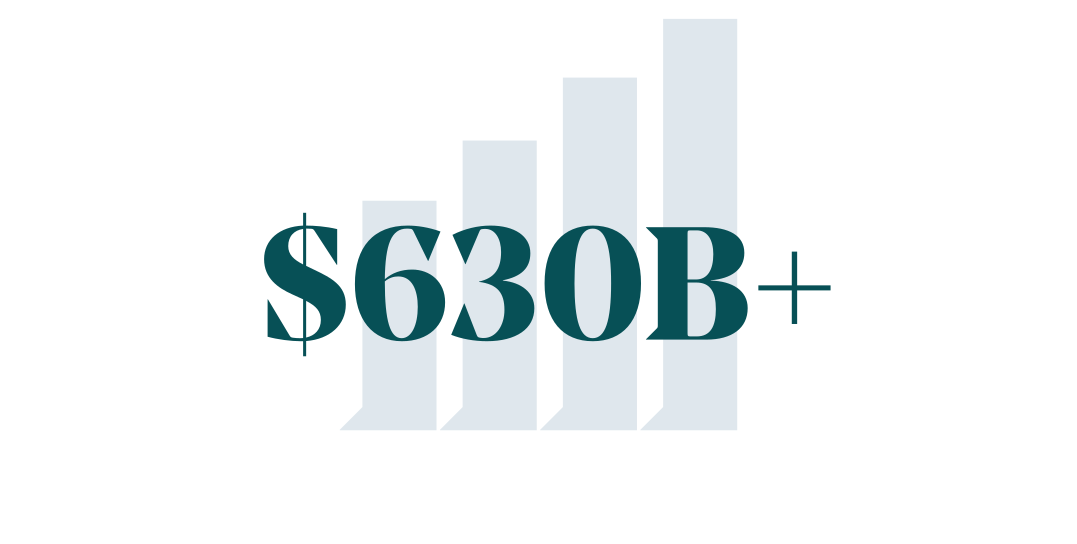
Why it matters: According to IDC, global AI spending is projected to exceed $630 billion by 2028. Enterprises that lack a structured AI roadmap risk falling behind peers who are already aligning technology investment with long-term business outcomes.
3. Responsible AI Is Not Optional. It's Foundational.
Duffey identifies responsible AI as one of the three universal priorities he hears across industries. This includes how models are built and governed, how proprietary data is used, and how organizations manage risk at scale.
He also noted encouraging signs of public-private collaboration, with legislators creating structured frameworks where organizations can bring novel AI use cases for policy guidance before they go to market.
Why it matters: The World Economic Forum has identified AI governance as a systemic risk requiring coordinated action. For enterprise leaders, responsible AI is increasingly a brand, legal, and operational imperative, not a compliance checkbox.
4. Content Credentials Are the Next Frontier of Brand Trust
Duffey described Adobe's investment in what he calls "content credentials," part of a broader industry initiative that embeds traceable metadata directly into AI-generated content, functioning like a digital nutritional label.
"You can see embedded into the content that's getting generated how it was trained, how it was augmented, how it was distributed."
This initiative now spans hardware, software, and media companies across thousands of organizations.
Why it matters: As synthetic content becomes indistinguishable from original work, provenance and authenticity will become competitive differentiators. Brands that can demonstrate the integrity of their content pipelines will earn and keep consumer trust.
5. Prompting Is a Creative Skill and a Strategic One
Perhaps the most counterintuitive insight: Duffey argues that Generative AI isn't diminishing creativity. It's elevating a different dimension of it. The craft is shifting from production execution to precision in language and intent.
"I think artists are going to hopefully re-fall in love with the art of language on how it can impact creativity going forward."
In this model, the ability to articulate a vision with precision, nuance, and specificity becomes the new creative edge.
Why it matters: For enterprise leaders investing in creative teams and content operations, this signals a reskilling imperative. The most valuable creative professionals going forward will combine domain expertise with the ability to direct AI tools with clarity and intent, a skill set that requires deliberate development.
As Generative AI reshapes creativity and marketing operations, organizations that align technology, governance, and talent will unlock the greatest value.
Explore how Perficient delivers solutions on Adobe Experience Cloud.
These insights come from Chris Duffey's appearance on Perficient's What If? So What? podcast.