

When 300 Websites Become the Problem
A Fortune 100 smart technology provider had a digital estate that had grown faster than anyone could manage it. More than 300 disconnected websites. Customers landing on the wrong pages, hitting dead links, and abandoning searches mid-funnel. Sales cycles slowing because buyers couldn't find basic product information.
The problem wasn't operational complexity. It was lost revenue from customers who couldn't complete simple tasks.
A Strategy Built Around How Customers Actually Buy
We started where the friction was — not where it was easiest to look.
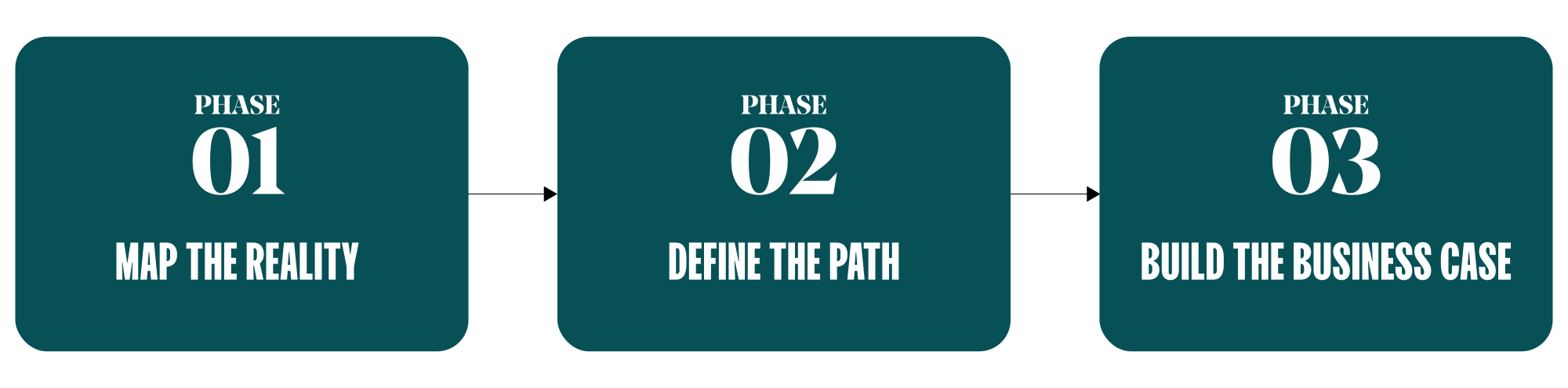
Stakeholder interviews and workshops surfaced the pain points that weren't showing up in dashboards. Our UX IQ assessment evaluated 100 usability markers across the client's properties, tracking user flows to pinpoint exactly where customers got stuck and why. A full content and SEO audit crawled primary sites to inventory keywords, review architecture, and benchmark competitors. Site performance data identified drop-off points. Personalization and demand generation capabilities were assessed against what the experience actually needed to deliver.
The diagnosis was clear: fragmentation wasn't just an IT problem. It was a revenue problem.
From there we built a strategic vision grounded in customer data, not aspirational language. Visual prototypes and a future-state experience map showed leadership what the consolidated experience would look like from the customer's perspective — concrete, not conceptual. A site consolidation decision tree and prioritization workshops defined what to build, and in what sequence.
We developed ROI projections and a multi-year roadmap, then partnered with the CMO to present the case at the executive level. Strategy without organizational alignment doesn't move. We made sure this one did.
From Fragmented Estate to Connected Customer Journey
The execution focused on what actually drives conversion:
- Navigation and UI upgrades that make it easier for customers to find what they came for
- Content optimization using Generative AI to enforce consistency across properties
- Data and analytics capabilities to enable personalization and track behavior across the journey
- Operational restructuring to break down the silos that created the fragmentation in the first place
- Website consolidation to eliminate unused properties and cut maintenance overhead
Quick wins — redesigned navigation, standardized forms, optimized lead capture, expanded image library — delivered immediate momentum while the longer-term consolidation took shape.
The fragmented digital estate that was costing the business revenue is being replaced by a unified experience built around how customers actually buy. Fewer dead ends. Fewer abandoned searches. A digital presence that reflects the scale and sophistication of a Fortune 100 brand.
That's the difference between digital sprawl and digital strategy.