

Key Takeaways
- Marketing has more data, content, and technology than ever, yet it still struggles to earn its seat at the revenue table.
- This is not a marketing failure; it is a sales operations crisis.
- When sellers are buried in administrative work, marketing's high-value leads, intent signals, and messaging disappear.
- To bridge this structural gap, organizations must transition to an Agentic Front Office.
- By embedding autonomous AI agents directly into sales workflows, we can reclaim sales capacity, align GTM operations, and turn live deal activity into a dynamic feedback loop that powers marketing as a true growth engine.
The GTM Structural Gap: Why Marketing Disappears in the Deal
Every year, marketing organizations invest heavily in campaigns, intent data, and personalization. Yet, a persistent structural gap remains between what marketing produces and what sellers actually use. When sellers lack capacity, marketing's hard work disappears: leads sit untouched, intent signals are ignored, and messaging never reaches the moment that matters. Sellers default to what they know or have time for.
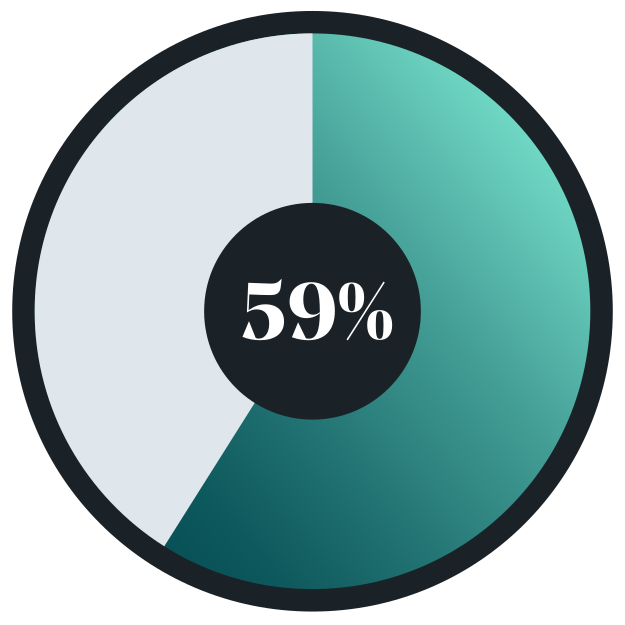
This is a structural capacity gap. An internal Perficient sales survey revealed that 59% of our sellers spent 40% or more of their week on non-selling activities, with nearly a quarter spending 50% or more. They rated tool effectiveness at just 3.9 out of 10. Sellers were rebuilding context and content daily — searching for messaging, re-reading old deal notes, and manually logging CRM activities. They lacked the capacity to learn about new campaigns or understand why they mattered.
Reimagining the Front Office: The Agentic Approach
To solve our seller's capacity constraint, we had to ask: What would it take to give sellers their time back? The answer wasn't better enablement; it was reimagining GTM operations through an Agentic Front Office.
In an Agentic Front Office, AI agents actively participate in workflows, decisions, and execution alongside humans. This isn't about adding tools; it's about redesigning how work gets done. At Perficient, our agentic transformation is guided by three core principles with business outcomes at the center:
- Unlock Context for Agents: Ensuring agents have access to deep, real-time data across the organization.
- Right-Size Agent Operations: Designing agents with specific, bounded roles and clear guardrails.
- Enable an Agentic-Ready Workforce: Preparing our people to shift from executing manual tasks to orchestrating outcomes.
With these principles in mind, we launched our first seven specialized agents — including Sales, Slackbot, Sales Pitch Coach, Account Research, Origination, Proposal, and Opportunity Shaping — to support sellers directly in their daily Salesforce and Slack workflows.
The Architectural Blueprint for Perficient's Agentic Transformation
Deploying agents is only half the battle; the real challenge is operationalizing them. To make our agentic front office work, we rebuilt our operational architecture across four distinct layers:
- System of Context: Feeds agents real-time account intelligence, competitor signals, and trusted CRM data via Data 360 and Databook.
- System of Work: A fresh Salesforce Sales Cloud instance that simplifies complexity and provides a clean foundation of business logic orchestrated by agents.
- System of Agency: Supervised Agentforce agents with limited autonomy and strong guardrails, expanding as trust grows.
- System of Engagement: Agents embedded directly where our teams already work — Slack and Salesforce — eliminating application-switching friction.
This transformation was accelerated by our AI-led delivery model. We used GitHub, Claude Code, and Swantide to read metadata, write configurations, and generate code under human oversight, drastically reducing deployment timelines.
Turning Deal Activity into Marketing Advantages
When you run sales workflows through an agentic architecture, deal activity is transformed into live, actionable signals. This unlocks five distinct marketing advantages:
- Real-Time Account Engagement: Engage target accounts the moment intent shows up, rather than weeks later after the lead has gone cold.
- In-Flight Message Evolution: Evolve and refine messaging while a deal is still in motion, based on real-time feedback from the sales cycle.
- Dynamic Pipeline Activation: Turn live opportunities into dynamic audiences, allowing marketing to activate pipeline rather than just analyze it after the fact.
- Precision Content Deployment: Scale high-performing marketing content into reusable, deal-ready assets and deploy them precisely where they can move the needle.
- Stall Visibility and Intervention: Gain clear visibility into exactly where and why deals stall, enabling targeted, high-impact interventions.
A Unified Revenue System Made Possible with an Agentic Front Office
Imagine a front office where a seller walks into a meeting already briefed by an agent, marketing has already adjusted the messaging based on live competitor signals, and the outcomes of that meeting automatically feed the next marketing campaign. This is not a futuristic vision; it is the reality of the Agentic Front Office. By solving the sales capacity crisis, we don’t just align sales and marketing — we unite them into a single, continuous revenue system where marketing acts as a true growth engine.