

The Real Takeaway
- AI accelerates regulated documentation, reducing manual effort and improving submission quality.
- Agentic AI boosts development velocity by decomposing tasks and automating peer review.
- AI‑enabled QA improves regression cycles and coverage by automating test generation and analysis.
- AI-fluent talent is essential to operationalize AI safely in regulated environments.
- Scaling AI requires structured governance, domain expertise, and a partner who understands MedTech.
AI is quickly becoming a differentiator for MedTech companies under pressure to innovate, whether they’re developing embedded software, modernizing labs, or scaling digital platforms. When integrated into the software development lifecycle (SDLC), AI reduces costs, speeds delivery, strengthens compliance, and positions organizations to scale with confidence. But AI isn’t plug‑and‑play. It takes a partner who understands regulated environments, complex SDLC processes, and the strategic levers that drive both growth and safety.
Our teams help MedTech leaders move from experimentation to execution by embedding AI into product development, testing, and regulatory readiness. As noted in the Reuters MedTech Report (2025), AI is already being used to reduce manual effort and improve accuracy in documentation, testing, and validation, a trend echoed in Perficient’s own MedTech SDLC analysis.
AI-Accelerated Regulatory Documentation
Outcome: Faster submissions, reduced manual burden, higher compliance confidence
Regulatory documentation remains one of the most labor-intensive phases of medical device development. AI helps teams get ahead by automating and elevating core processes:
- Risk classification automation: AI analyzes device attributes and applicable standards to recommend classification and required documentation.
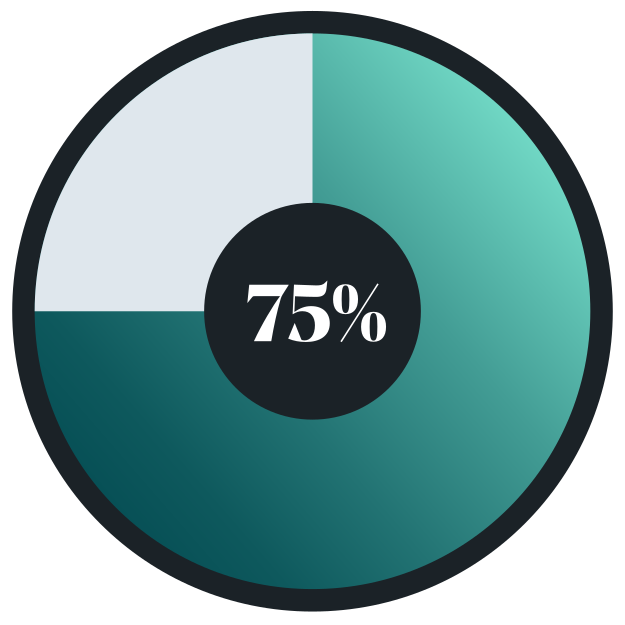
- Drafting and validation: Generative AI can produce up to 75% of draft documentation, which experts then refine and validate.
- AI-assisted review: After human editing, AI re-analyzes documents to flag gaps or inconsistencies, serving as a built-in quality check.
The result: faster submissions, less rework, and more confidence in compliance.
"AI isn’t replacing regulatory specialists—it’s removing repetitive work so teams can focus on higher-value decisions."
Agentic AI in the SDLC
Outcome: Higher development velocity, reduced errors, scalable automation
Agentic AI—multiple specialized AI agents working together—is emerging as a force multiplier for engineering teams.
- Task decomposition: Complex development activities are broken into smaller tasks, improving accuracy and reducing hallucinations.
- AI-driven peer review: One AI agent validates another’s output, mirroring human review and improving reliability.
- Digital workforce augmentation: Repetitive tasks like documentation scaffolding or test case generation shift to AI, enabling engineers to focus on innovation.
- Built-in guardrails: We implement security controls, human oversight, and compliance checkpoints to ensure safe, responsible scaling.
Agentic AI helps identify issues earlier by validating outputs across multiple agents, serving as a quality amplifier rather than a replacement for engineers.
AI-Enabled Quality Assurance and Testing
Outcome: Improved consistency, faster regression cycles, better user outcomes
AI is transforming QA from a bottleneck to a competitive advantage:
- Smart regression testing: Automated AI frameworks identify regressions across releases with minimal human input.
- Synthetic data generation: AI produces accurate, privacy-safe test data in minutes instead of weeks.
- GenAI-powered visual testing: AI evaluates UI consistency and accessibility to catch issues traditional automation often misses.
- Chatbot validation: AI verifies the accuracy and compliance of conversational support tools.
As products become more intelligent, QA must evolve in parallel, and AI‑enabled testing strengthens consistency and scalability across releases.
AI-Enabled, Scalable Talent Solutions
Outcome: Domain expertise without long onboarding cycles
Even the strongest AI initiatives succeed only when teams know how to deploy them effectively. We provide AI-fluent talent—regulatory technologists, QA engineers, data scientists—who bring immediate value in regulated environments.
- Faster proof-of-concept execution: Teams plug directly into Agile and SAFe workflows to deliver iterative results.
- Lower training burden: Specialists arrive AI-ready, reducing time spent bringing teams up to speed.
- Compliance-aligned development: Experts embed quality, traceability, and governance into every SDLC phase.
We see that organizations benefit from talent that integrates seamlessly into regulated workflows and accelerates outcomes without long onboarding cycles.
From Pilot to Enterprise Scale
Outcome: Smart investment decisions and future‑ready capabilities
AI capabilities across the SDLC are already in pilot or early deployment at many MedTech organizations. Industry research shows that roughly two‑thirds of MedTech companies are implementing GenAI, though many remain in pilot while a smaller group is scaling and seeing measurable impact.
Our structured approach meets organizations where they are, delivering value from day one while building toward long‑term, enterprise‑level transformation.
As you consider your roadmap, ask:
- Are we spending too much time on manual documentation?
- Do we understand our risks and mitigations clearly?
- Can our QA processes scale with growing product complexity?
- Are we building responsible AI governance?
- Do we have the right partner to operationalize AI?
AI Needs a Partner, Not Just a Platform
AI isn't a regulatory burden. It's a growth lever. For MedTech companies, success means scaling AI with precision, governance, and confidence built in. The winners will be those that treat compliance as a competitive advantage, not an afterthought.
Across engineering, clinical operations, and business leadership, AI is changing how MedTech organizations build and deliver value. Those that balance speed with trust will define the next wave of innovation.
Explore how Perficient helps organizations in the Healthcare and Life Sciences industry transform their business.