
The Real Takeaways
Utilities don’t have a meter problem. They have a data problem.
Until organizations address the integration, management, and accessibility of their AMI data, investments in next-generation meters will fall short of expectations. The priority is clear: before upgrading meters, utilities must upgrade their ability to use data.
Utilities Are Betting on the Wrong Upgrade
Utilities are under pressure. Aging infrastructure, regulatory scrutiny, and rising customer expectations have made advanced metering infrastructure (AMI) a centerpiece of grid transformation strategies.
For many organizations, the path forward seems obvious: upgrade to AMI 2.0. After all, new meters promise better connectivity, more data, and advanced capabilities. On paper, the value is tempting. But in practice, utilities are at risk of making a costly mistake.
They’re upgrading the hardware — without fixing the data foundation required to realize ROI.
AMI 2.0 Could Magnify Today’s Data Failures
AMI 2.0 deployments are a significant financial commitment. Large-scale rollouts can cost billions and take years to complete. To justify that investment, utilities must prove to executives, regulators, and customers that it will deliver measurable outcomes, from reduced costs to improved reliability and better customer experiences. When utilities face challenges like inconsistent meter communications, incomplete data, and limited visibility into grid events, it’s tempting to look to AMI 2.0 as the solution. But these aren’t meter problems. They’re data problems.
In this environment, deploying more advanced meters only amplifies the problem. Instead of unlocking new capabilities, it introduces more data into systems that aren’t equipped to manage or use it effectively.
Outcomes don’t come from meters alone. They come from how effectively the organization can use the data the meters generate. If that data isn’t integrated, clean, and accessible across operational teams, the ROI of AMI 2.0 never materializes.
“Utilities risk deploying millions of meters and billions in capital without delivering measurable ROI if the underlying data systems aren’t ready.”
AMI 1.0 Is More Powerful Than Utilities Realize
Ironically, most utilities don’t need more data. Smart meter penetration already exceeds 80% across North America, according to Berg Insight. Utilities need to better use the data they already have.
AMI 1.0 systems generate a rich stream of telemetry:
- Consumption and load patterns
- Voltage fluctuations and anomalies
- Outage indicators and device health signals
- Early warning signs of customer-facing issues, like unexpected bill spikes
This data has the potential to inform outage detection, optimize field operations, enable predictive maintenance, and improve customer service. But in most organizations, AMI data remains siloed, locked within meter operations teams and underutilized by downstream systems.
“From a data perspective, the leap from AMI 1.0 to 2.0 is smaller than most expect. The real difference is how effectively that data is used.”
The Real Prerequisite for AMI ROI
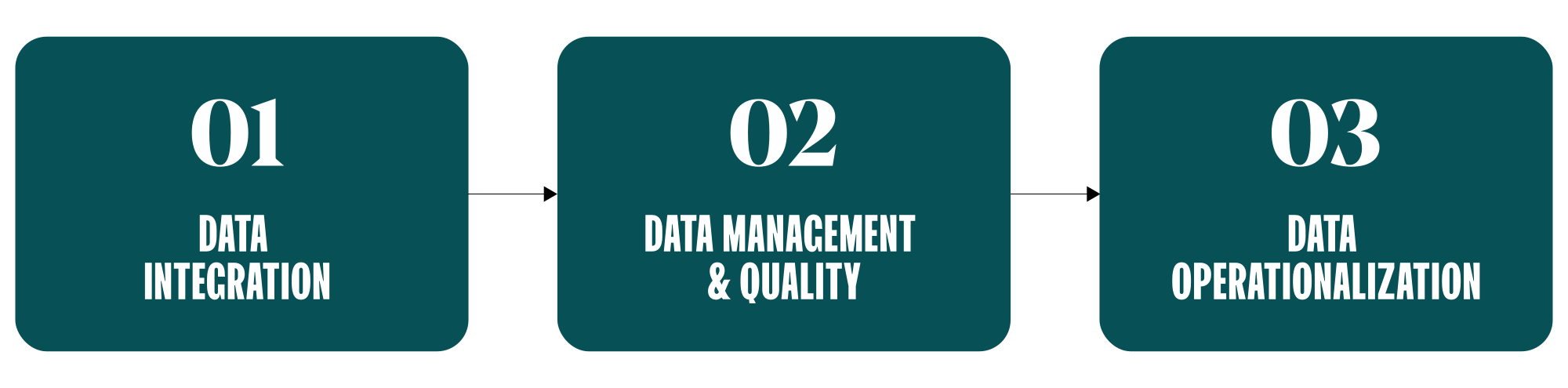
To unlock ROI from AMI — whether 1.0 or 2.0 — utilities need a robust data foundation. That means addressing three core data capabilities:
1. Data Integration
AMI data often lives in an MDMS and flows primarily to billing. Other systems — OMS, SCADA, GIS, SAP, and IoT feeds — operate on separate data models with no shared layer. Integrations are typically one-off, brittle, and batch-based. As a result, there is no shared operational view.
Breaking down these silos is foundational. Without integration, AMI data cannot support cross-functional use cases or real-time decision-making.
2. Data Management & Quality
Many utilities manage known data issues reactively. Missing reads, duplicate records, and inconsistent timestamps reduce trust in the data and limit its usability.
A modern data foundation requires:
- Centralized ingestion of AMI and enterprise data
- Automated quality checks and anomaly detection
- Governed data models that support consistent use across teams
Without clean data, even the most advanced meters won’t drive meaningful outcomes.
3. Data Operationalization
The real value of AMI comes from cross-functional usage. Once AMI data is integrated with other critical data systems across teams, the same dataset can be repurposed to solve for many use cases:
- Help define outage boundaries
- Enrich field dispatch tickets
- Guide vegetation management decisions
- Enable proactive customer communications
Without accessibility across teams, those use cases remain unrealized.
The Shift From Meter Deployment to Data Activation
Leading utilities are shifting their focus from hardware upgrades to data activation. And the payoff is measurable.
Utilities that have integrated their operational and data environments are already seeing meaningful improvements, including 13% lower operating costs, according to IBM. These gains are not driven by new hardware. They result from making existing data integrated, clean, and accessible across the organization.
By prioritizing data readiness, utilities can start unlocking ROI without waiting years for a full AMI 2.0 rollout. More importantly, they build the foundation needed to support future capabilities, from advanced analytics to intelligent automation and beyond.
Meters Won’t Deliver ROI. Data Will.
The opportunity in AMI isn’t new hardware. It’s in activating the data that utilities already have.
AMI becomes truly valuable when its data flows across functions, informs decisions in real time, and drives coordinated action across the organization. Utilities that focus on data readiness today will be better positioned to realize the full value of AMI both now and as the grid continues to evolve.
Learn more about how Perficient delivers ROI for AMI.