

The Real Takeaway
As digital products grow more complex and AI-driven, usability challenges are no longer just visual. They are structural.
Experience architecture provides the foundation that aligns UX, CX, and intelligent systems so products remain understandable, scalable, and trustworthy over time.
But speed has come with a side effect. As organizations rush to embed AI into customer and employee experiences, many discover that the limiting factor is no longer the technology itself. It is how that technology fits into existing workflows, decision-making processes, and user expectations.
Faster release cycles, data-driven decisions, and constant feature expansion all push teams toward whatever is easiest to ship and measure. That pressure has a cost.
As interfaces improve and feature sets expand, many systems have become harder to understand. Navigation fragments, workflows become inconsistent, and teams spend increasing time fixing isolated journeys: an onboarding flow here, a customer-service process there, a transaction experience somewhere else.
In many cases, the problem is the underlying structure.
The Layers of Modern Experience Design
When organizations talk about digital experience, several related disciplines tend to get grouped together.
User Experience (UX) focuses on how people interact with a system to accomplish tasks.
Customer Experience (CX) focuses on the broader relationship between people and an organization across touchpoints and time.
Experience architecture shapes how information, workflows, and capabilities are organized so that UX and CX can function coherently across a product ecosystem.
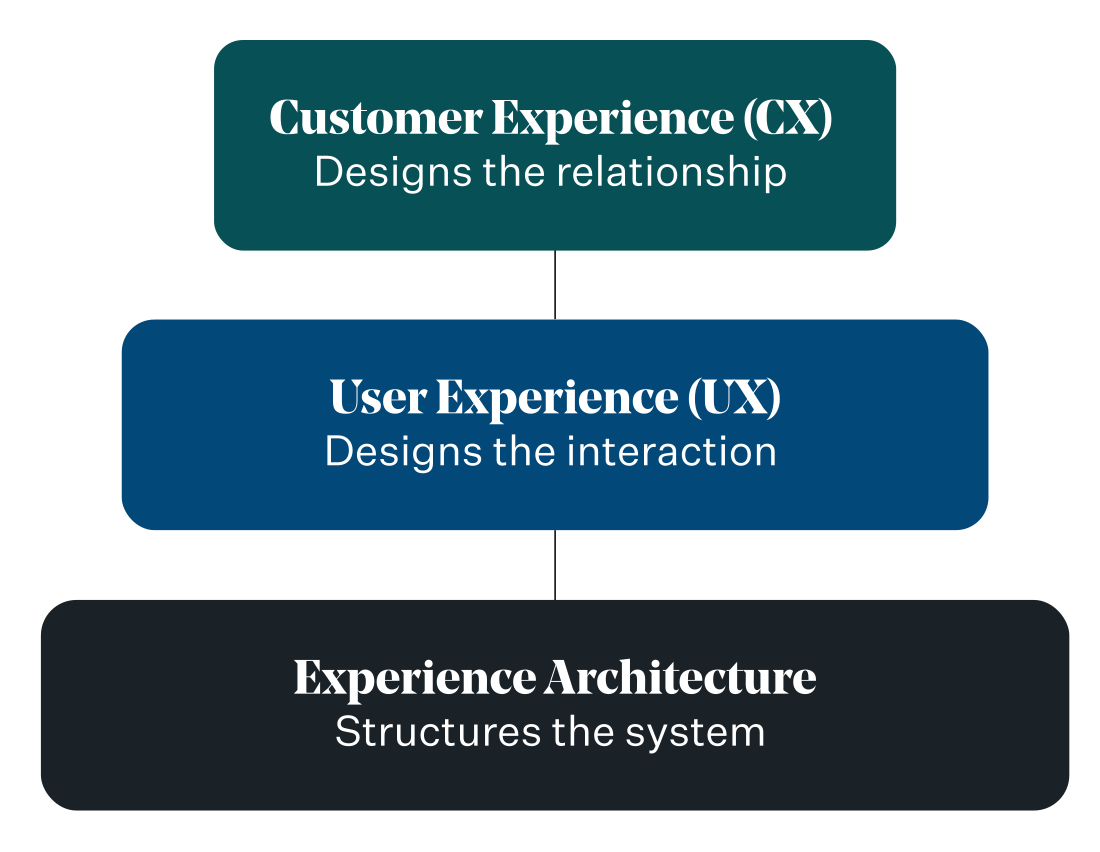
When this layer is strong, usability improvements scale across the product. When it is weak, teams repeatedly redesign journeys, workflows, navigation models, and interaction patterns while the same underlying issues persist.
A Lesson from Human Factors
UX originally emerged from disciplines such as human factors and ergonomics, which studied how people interact with tools in real-world environments.
One well-known example comes from aviation during World War II.
Pilots were accidentally raising landing gear instead of flaps during landing. The controls were identical in shape and located close together.
Human-factors researcher Alphonse Chapanis redesigned the controls so they could be distinguished by touch. The errors disappeared.
The pilots hadn’t been the real problem. The design of the system was.
The lesson remains relevant today. People tend to blame users when mistakes occur repeatedly, but recurring errors often reveal a mismatch between how a system is designed and how people naturally process information and make decisions
Many modern usability problems are symptoms of deeper architectural issues rather than isolated interface flaws.
The Role of UX Architecture
Most organizations would never build enterprise software without technical architecture. Yet many create digital experiences without an equivalent blueprint for how users navigate information, decisions, and workflows across the system.
UX architecture provides that blueprint.
It includes:
- Information architecture
- Navigation structures
- Task flows
- Interaction models
- Content hierarchy
- Alignment with user mental models
This layer does not replace usability principles but instead lets them scale across products, channels, and teams.
Simply put:
UI expresses usability.
UX architecture enables usability.
UI
| UX Architecture |
|---|---|
Expresses usability
|
Enables usability
|
What users see
| How the system works |
Interface layer
| Structural layer |
As with software architecture, these decisions occur before interface design and influence what becomes possible as systems evolve.
Designing for Long-Term Trust
Digital systems operate within relationships of trust. When products become confusing, inconsistent, or opaque, the consequences extend beyond user frustration.
Customers abandon experiences before completing important tasks. Employees create workarounds outside intended processes. Support teams spend more time resolving preventable issues. AI-generated recommendations are ignored because users lack confidence in how those recommendations were produced.
Short-term performance metrics may not immediately reveal these problems. Over time, however, they appear as slower adoption, rising support costs, operational inefficiencies, and diminished confidence in new digital capabilities.
Clarity and transparency are therefore not just design ideals. They are business assets.
Organizations that succeed often invest in
- Systems mapping
- Design research
- Information architecture
- Interaction design
- Design systems and governance
These capabilities help maintain coherence as products, services, and AI-enabled experiences scale.

Closing the AI Value Gap
Many organizations today are investing heavily in AI capabilities while struggling to translate those capabilities into meaningful user outcomes.
Part of the reason is that AI behaves differently from traditional software.
Traditional interfaces present fixed options and predictable outcomes. AI systems generate responses dynamically and adapt to user behavior, which shifts the real design challenge from interface to intelligibility.
Users need to understand:
- What the system can do
- Where its limitations exist
- When AI is influencing outcomes
- How their actions affect results
- Where human judgment remains necessary
Without that clarity, AI can feel unpredictable or opaque.
AI features are often layered onto systems that were not designed to support them. Without strong experience architecture, these capabilities often feel disconnected from real workflows.
The result is often low adoption, inconsistent usage patterns, and AI investments that struggle to produce measurable business impact.
Experience architecture helps close that gap by defining how AI capabilities fit into the broader experience. It creates a framework that helps users understand when to engage with AI, how to interpret its outputs, and how those outputs support the task at hand.
Without Experience Architecture

With Experience Architecture

Closing the gap between AI capability and business value requires more than adding intelligent functionality. It requires designing systems that help people understand, trust, and use that intelligence effectively.
Looking Ahead
The fragmentation of UX, CX, and product disciplines did not occur by accident. It emerged from real market pressures and technological change.
But as systems grow more complex, and AI becomes embedded across products and services, organizations are rediscovering a simple truth:
Interfaces alone cannot sustain coherence. What enables durable digital systems is architecture, both technical and experiential.
When experience architecture provides that foundation:
- UX can support effective interaction
- CX can guide long-term relationships
- Product teams can balance business goals and user needs
The result is systems that remain coherent, adaptable, and resilient as complexity grows.
The organizations pulling ahead are not the ones with the most AI features. They are the ones auditing experience architecture before the next AI investment, not after the confusion shows up in adoption numbers.