

Key Takeaway
Healthcare organizations need AI healthcare concierge experiences that do more than answer questions. They must connect patient intent to action — scheduling appointments, checking statuses, resolving issues, and helping patients move forward without starting over.
Healthcare Chatbots Deflect Requests, But Patients Need Resolution
Healthcare chatbots did what they were built to do: answer basic questions, route requests, and give overburdened contact centers some relief. That was useful. It is no longer enough.
Patients are not looking for another digital front door that points them elsewhere. They need help completing the next step: finding the right provider, scheduling an appointment, checking referral status, resolving prior authorization questions, or understanding what happens next.
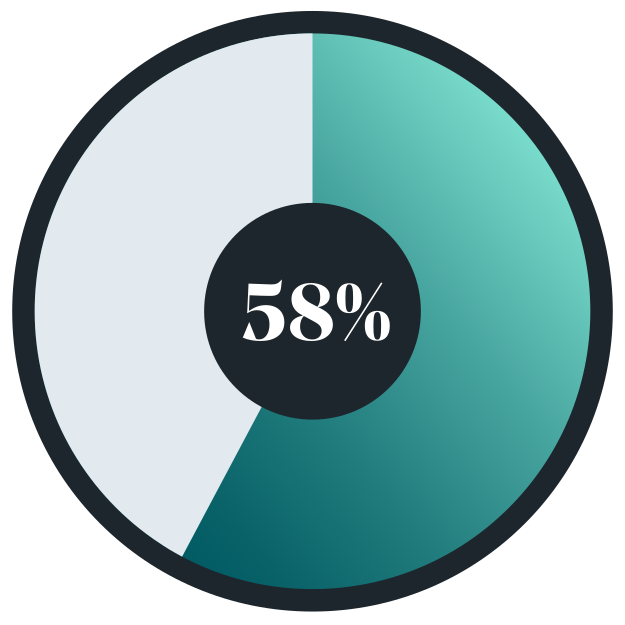
Salesforce’s 2026 Connected Health Consumer Report found that 58% of patients delay or skip care because scheduling is too difficult, while 67% would rather get 24/7 AI help than wait for office hours.
Patients are not rejecting AI. They are rejecting AI experiences that still make them do the hard part.
Traditional chatbots can point patients to scripts, handoffs, and links. But healthcare access requires more than explanation. It requires resolution and a different model built around action, context, and connected workflows.
AI Concierge Experiences Turn Patient Intent Into Action
The next standard is not a better chatbot. It is an AI healthcare concierge. The difference is not tone, branding, or conversational polish. It is what the system can do on the patient’s behalf and how information is delivered.
A chatbot answers:
- “Here is a link.”
- “Here is a phone number.”
- “Here are office hours.”
- “Here is a list of providers.”
- “Let me route you to someone.”
An AI healthcare concierge can:
- Understand patient intent in plain language
- Carry context across the conversation
- Match needs to the right provider, service, or workflow
- Check availability, location, preferences, and coverage
- Connect to EHR, scheduling, CRM, payer, portal, and workflow systems
- Book the appointment, check status, or escalate with context intact
- Deliver easy-to-understand healthcare information enriched with relevant images, videos, and existing content
A true AI healthcare concierge is not just a smarter chat window. It can respond through voice or text, but it can also present next-step guidance, service details, instructions, content, and status updates in a format that feels more like a personalized digital experience than a static FAQ.
Generative AI makes this possible because patients should not have to know the exact department, specialty, service line, or scheduling path to get help. They should be able to describe what they need and move forward.
But generative AI alone does not solve access challenges. The conversation only matters if it connects to the systems, rules, and workflows that determine what can happen next.
Healthcare AI Needs Context to Complete Patient Workflows
Healthcare is too personal, regulated, and operationally complex for generic AI experiences. A patient does not simply need “a specialist.” They may need a provider who is accepting new patients, in network, near home, available soon, clinically appropriate, and aligned to a referral or authorization requirement. That takes context.
According to an April 2026 Forrester Consulting study commissioned by Hyland, From Content to Intelligence: A Spotlight on Healthcare, 54% of respondents at healthcare organizations report using AI agents today, but only 9% have scaled them enterprise-wide. The study also found that 74% of healthcare decision-makers believe context unlocks the true power of AI agents, yet only 16% consider their organizations truly context-aware.
That gap explains why many AI investments stall. Organizations layer conversational interfaces on top of fragmented systems and expect connected experiences to follow. They do not. Without access to the systems, data, rules, and workflows behind patient care, AI lacks the context needed to support meaningful action. It may answer the patient’s question but fail to complete the work behind it.
With that foundation in place, AI can reduce repeated questions, keep requests from getting stuck, and prevent patients from starting over every time they move between channels.
It also makes human support better. Not every healthcare interaction should be automated. That is not the goal. The goal is to give patients a clearer path and provide care teams with better context when human support is needed.

Measure Healthcare AI by Completed Care Steps, Not Call Deflection
Efficiency has shaped healthcare technology investments for years. The result is often dashboards full of activity rather than progress. Metrics such as call deflection are not wrong. They are simply incomplete.
Healthcare leaders should measure AI by its ability to move care forward through completed care steps, including:
- Appointments scheduled
- Referrals completed
- Prior authorization statuses resolved
- Waitlist requests handled
- Follow-up care coordinated
- Repeat contacts reduced
- Time to resolution improved
- Staff capacity returned to higher-value work
This matters because the most frustrating healthcare moments are rarely simple information requests. They are unfinished workflows.
Forrester Research Inc., noted in its blog Agentic AI in Healthcare: A New Era Of Intelligent Automation (Jul 23, 2025) that the U.S. healthcare system spends more than $1 trillion annually on administrative costs, much of it tied to knowledge work across care and operational workflows.
This is where connected AI creates value, not by containing demand, but by completing the work that gets stuck, repeated, or fragmented across systems and teams.
AI Healthcare Concierge Experiences Must Resolve Requests, Not Redirect Patients
Most health systems already use AI somewhere in the patient experience. That alone is no longer a differentiator. What matters is whether AI helps patients take the next step.
A chatbot provides basic text responses. An AI healthcare concierge understands patient intent and delivers personalized, guided support that creates a simpler, more connected path to care.
Perficient helps healthcare organizations evolve from disconnected chatbot interactions to AI healthcare concierge experiences that improve provider access, scheduling, referrals, prior authorizations, and follow-up care. We bring together the integration, governance, and execution needed to streamline workflows, reduce friction, and improve patient outcomes.