As AI agents gain autonomy, the real transformation isn’t faster production but the move toward design systems that assemble, respond, and act in real time.
Brian Flanagan, Eve Sangenito, Mark Ursino, and Keith Wolf
The Real Takeaway
AI shifts experiences from static pages to dynamic systems that adapt in real time. To lead in this era, Experience Leaders must design interfaces that can assemble in real time based on user context and intent. They need to use AI to amplify human judgment rather than replace it, enabling experiences that can execute multi-step tasks with limited supervision while depending on safeguards. Building responsible AI guardrails from the start is essential, as is optimizing for discoverability by both humans and AI agents.
In the race to adopt AI, the real winners aren't the ones spending the most on compute. They're the ones rethinking the work itself. At Perficient, we've seen that the most meaningful gains happen when enterprises stop viewing AI as a replacement for human effort and start using it to amplify human imagination.
We've spent the past two years helping enterprises navigate this shift. Here's what we've learned about the transition from static digital assets to dynamic, generative ecosystems.
AI Is Accelerating Every Stage of the Design Process
We see AI as a catalyst that elevates the entire experience design lifecycle: from exploration and insight through concepting and refinement. The impact isn't uniform across disciplines. It's specific to each, and it compounds.
Research teams can analyze qualitative data far more efficiently and distill patterns sooner. Design teams can explore broader conceptual terrain in a fraction of the time. Strategists can connect insights to opportunities with more precision. But speed isn't the goal on its own. The real advantage is in the quality of thinking AI helps unlock.
"It's easier to get to that strong starting point, so teams can focus on refining and elevating the work."
— Brian Flanagan
Practically, this means AI gives teams more time for the human parts of design: judgment, innovation, empathy, and imagination. The work doesn't get easier. It gets better.
AI Is Making Design More Collaborative and Multidisciplinary
One of the clearest trends we see is the softening of historical boundaries between disciplines. Designers, researchers, and developers now collaborate more fluidly because AI creates a shared understanding of problems, solutions, and opportunities across functions and in real time.
This shift isn't just about speed. It's about fluidity. The traditional hand-off model is disappearing.
"Barriers that once existed are now blurred in a really positive way. We're seeing more overlap, more shared problem solving, and more fluidity across the workflow."
— Keith Wolf
This blending of perspectives strengthens the product, the process, and the final experience. When everyone can contribute to more of the work, the work reflects more of what customers actually need.
The Shift to Agentic Experience Design
As AI becomes embedded in digital systems, user expectations are shifting from static consumption to active orchestration. We're moving from fixed paths to the Agentic Customer Experience.
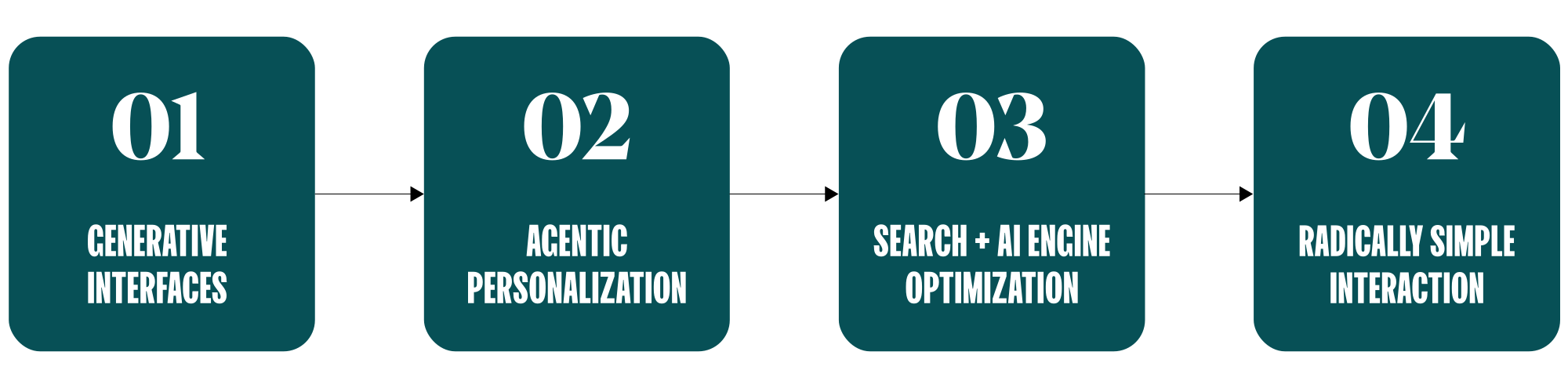
Perficient sees four principles defining exceptional experiences in this new era:
Generative Interfaces: Moving beyond pre-built templates. The UI is assembled in real time based on intent, context, and behavior, meeting the user with exactly what they need in the moment.
Agentic Personalization: Moving from next-best action to autonomous assistance. These experiences don't just suggest. They act on the user's behalf and navigate complex tasks to deliver an outcome.
Search and AI Engine Optimization: Ensuring your brand is discoverable, understandable, and actionable to both people and the AI agents they use to navigate the world.
Radically Simple Interaction: Reducing effort through conversational, multimodal patterns. As backend intelligence grows, the front end should shrink. The technology recedes and the value takes center stage.
As experiences become more dynamic, design systems must evolve to support real-time assembly, context-aware logic, and continuous learning.
Responsible AI and Agentic Guardrails
With greater capability comes greater responsibility. The organizations leading in AI-enabled design aren't just moving fastest. They're moving most deliberately.
"Start with the problem you're solving, not with the AI. AI should be applied deliberately, not by default."
— Keith Wolf
At Perficient, responsible AI is a foundational expectation in every engagement, not a compliance layer bolted on at the end. In an agentic world this means keeping humans as the orchestrators of AI's actions, aligning every application to the brand's unique mission and values, maintaining clarity in how intelligent capabilities are applied and how data is used, and respecting regulatory requirements and client-specific safety protocols.
AI Is Elevating Roles and Amplifying Human Creativity
As AI takes on repetitive tasks, the role of the human creative becomes more strategic. Designers, researchers, and developers are shifting from producers to orchestrators, guiding systems rather than being constrained by them.
"The shift to Agentic Experience Design means we're no longer just designing pages. We're designing behaviors and outcomes. The value moves upstream to strategic execution."
— Brian Flanagan
This isn't a story about AI replacing creative talent. It's a story about talent operating with more leverage, more range, and more capacity to focus on what humans do best: understanding people and imagining new possibilities.
Leading the Agentic Experience Shift
The shift to agentic experiences is redefining how digital products are conceived, built, and evolved. Most organizations are experimenting with isolated AI tools. Very few are re architecting how design and engineering work together to compound the gains.
This is where Perficient leads. We bring the end-to-end perspective needed to connect strategy, design, and build so AI enhancements don’t just accelerate workflows, they elevate the entire experience layer. Our teams understand the technical and organizational foundations required for real-time, adaptive, agentic systems, and we help enterprises build the internal capability to sustain them.