

When we started designing the agentic front office for clients, we made a deliberate decision: build it in our own organization first. The agentic front office requires a level of organizational honesty that's hard to ask of clients without having done it yourself.
The Audit That Started Everything
Like most organizations, our front office had become too complex over time. The systems existed. The data existed. But sellers weren't using them the way anyone intended.
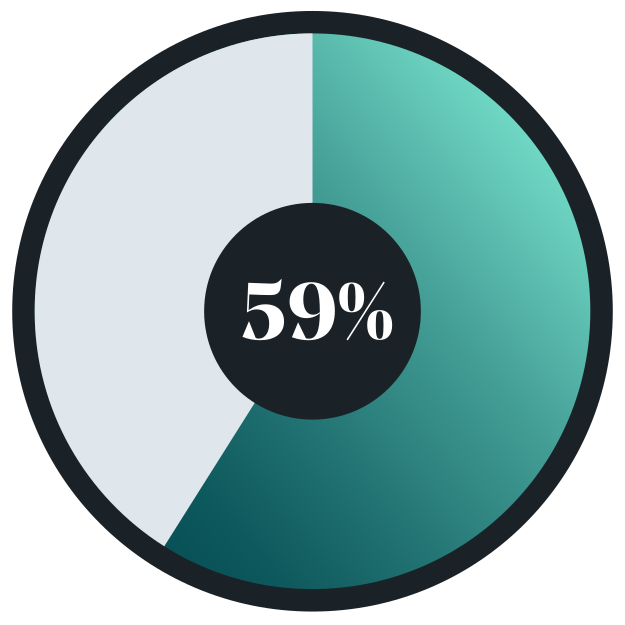
What we found was humbling. 59% of our sellers were spending more than 40% of their time on non-selling activities. When asked to rate the effectiveness of their tools, they scored their environment 3.9 out of 10.
Sellers were rebuilding context constantly: searching for the right message, rereading old notes, manually logging activity after the fact. One seller put it plainly: "We've automated bad processes and kept building on top of them without examining how to improve the baseline jobs to be done."
That was the real starting point. Not a product roadmap. An honest assessment of what wasn't working.
What an Agentic Front Office Actually Is
An agentic front office is an operating model you construct, and the sequence matters.
We're embedding agents into CRM, collaboration tools, and revenue workflows to surface context, automate coordination, and reduce the cognitive load that slows execution down. But none of that works until the underlying systems, data, and processes are integrated enough for agents to act with confidence.
Our MVP is built on Salesforce and a curated set of complementary solutions, including Swantide for environment scanning and configuration intelligence. The expected outcomes we're working toward, based on industry benchmarks:
- 30–50% increase in qualified pipeline
- 1 day per week of seller admin time saved
- 1 week faster deal cycle time
- 10–30% increase in win rate
We're not there yet. That's the point of doing this ourselves first.
What We’ve Learned so Far
- Get context from everywhere, not just your CRM. Critical decision-making data lives outside Salesforce. If agents can't reach it, they can't act on it.
- Uncover the hidden knowledge. The workarounds your team uses every day are competitive advantages worth capturing, not eliminating.
- Know where AI breaks down. Build safeguards for what current models can't do well. Expect those boundaries to keep shifting.
- Don't make everything an AI problem. Mixing agents with regular automation, workflows, and dashboards gets more reliable results faster than forcing everything through AI.
- Train humans to check the agent's work. Agents sound confident even when they're wrong. Your team needs to get good at quality checking.
- Build for customizable workflows. Successful implementations let users modify agent behaviors for their specific needs without requiring IT or developer resources.
- Create compound value across the enterprise. Success with one agentic use case generates insights that accelerate outcomes in unexpected places.
- Agentforce is a foundation, not a finish line. You need intentional setup, context enrichment, and governance to get real business results from it.
The Implementation Sequence That Actually Works
Our approach breaks into five phases, each with a specific output:
1. Perficient Flash Discovery & Environment Scan
Rapidly assess your sales operations to define opportunities and readiness for agent driven execution
2. Agent Mapping Toolkit
Convert priority opportunities into scalable use cases, guided by agentic maturity guardrails
3. In-Live Agent Activation
Deploy and validate agents in production with adaptive KPI tracking and disciplined change management
4. Agentic Value Pods
Orchestrate forward deployed engineers and value architects to deliver measurable business outcomes
5. Continuous Optimization & Expansion
Train, tune, and scale agents based on performance, adoption, and realized value
The key to this sequence: no months of strategy before anything goes live. You see results in phase 3, learn from them, and decide how to scale from there.
What This Looked Like for a Financial Technology Client
We worked with a financial technology client facing a familiar problem: qualified leads were getting lost in the handoff between demand generation and sales. The team was doing manual research, duplicate qualification, and context hunting across three different systems.
We deployed an agent focused on lead qualification. Here's what happened:
The results:
What the agent did: Cut through spam, scored leads, and surfaced customer context for sellers. It ran autonomously with quality checks and human review at key decision points — built as a supporting agent that enhances the work of human SDRs, not replacing them.
That distinction matters. The agent handled the work that was slowing qualification down. The SDRs handled the judgment calls. When you get that balance right, the numbers follow.
Where We Are Now
We're still in the middle of our own implementation. The benchmarks are directional. The learning is ongoing. But that's exactly what makes this credible. We're not selling a finished product. We're sharing what we know from doing it ourselves and offering to bring that into your organization.
Ready to explore how this works for your organization? See our agentic front office offering.